Saturday, June 13, 2015

The Basics of #SEO Every Entrepreneur Should Know

Creating revenue with a small amount of resources and the unlimited number of tasks associated with running a business are challenges every entrepreneur faces – and they aren't likely to change. You are likely short on time as you try to get your brand off the ground, create findability, and build an organization – which means you lack the bandwidth to learn and execute the daily tasks associated with every role.

When it comes to SEO, a few important basics can greatly improve your presence in the increasingly crowded online space.

Since SEO has evolve to include a content-centric view of rankings and incorporate social media and local engagements, there are fewer shortcuts and a larger focus on quality. While it sounds time-consuming, quality content has benefits that reach beyond SEO, as good content is useful across all marketing mediums, and forces you to think through messaging from a topic and keyword perspective – ensuring you're honing in on what actually matters.

Below are a few things I think are important:

Know Your Audience(s) and What They're Looking For

This is a helpful exercise regardless of whether or not you care about SEO. You've got to know who would buy your products or services, and what they're looking for, in order to find them. Your initial assumptions may be accurate, but you may also be missing things that could drive additional traffic, potential messaging opportunities, or new market segments.

You'll want to do some research up front (if you haven't already) and map an audience to the keywords, topics, and phrases they're using in and around your industry. It's also helpful to map the keywords and topics back to your content and the ways people are sharing it so you'll know what types of content perform best on each channel.

Topic and Keyword Content and Social Image

Image by author

If you don't have the time to go through that exercise in its entirety, a look at how people are currently finding your content using your analytics provider (like Google Analytics) is a good start.

Map Competitor Content

If you're looking for increased traffic, and not just any traffic but relevant traffic, you need to know what you're up against. Mapping out your competitors' content will help you understand what's already out there, what's missing, and how similar products and services are being messaged.

To get started, create a spreadsheet with the following information:

  • The competitor name (e.g. Acme)
  • The keywords / topics that you're targeting that they are also ranking for (e.g. "anvils")
  • The content they've created that is currently ranking above yours or in the top 10 on search engines (e.g. "how to trap a roadrunner" – be sure to include the title of the content as well as the URL.)
  • Note any key elements of the content such as videos, images, long-form content, lots of discussion on the post, etc.
  • Armed with this information, you can better allocate the limited time and resources you have to create content that truly stands out against the competition.

    Certain tools will do this for you automatically, and will also highlight things like search and CPC data, which can be a great option if you have a highly competitive or volatile market.

    track competitor content ranking

    Screenshot from ginzametrics.com

    Create a Content Repository

    Creating increased traffic and revenue comes from having the most useful content for your audience to consume. Whether that's in the form of landing pages, blogs, email, social media, ads, or other assets – you'll need to focus on the findability of your specific content. Having a content idea repository will ensure you've always got a list of topics and fresh information for your audience.

    In your repository should be the following:

  • Ideas for new content gathered from forums, Q&A sites, LinkedIn, etc. (Questions around your industry, products, and marketplace can be great blog posts, FAQs, Slideshares, videos, landing pages, and email subjects.)
  • Content ideas to ensure you're on par with your competitors when it comes to covering topics and questions in the industry and around your company.
  • Unique messaging for your brand and products based on the keywords from item number one.
  • Once you've done this, map keywords and topics back to each content topic to ensure you're writing with those in mind when it comes time to create the content.

    Set Keyword Expectations and Manage Them Accordingly

    You're going to want to run your keywords and topics through a tool like Google's Keyword Planner to make sure  the topics and keywords you have chosen have enough search volume and potential traffic to warrant time spent. Be sure to take into account the relevance of the search to your audience. The narrower the topic focus, the lower the traffic typically, but this is often offset by the accuracy and interest of the audience.

    For example, a broad search might be "running shoes" which has a very high volume and competition for space. You may not want to create content just for "running shoes". Instead, consider a focus that maps back to your content ideas and create keywords and topics such as "women's trail running shoes."

    Set Up Your Site & Content Structure for Success

    As you create content, you'll want to make sure each page is optimized for crawlability, page speed, mobile friendliness, and overall findability. Initial investment in a site audit or recommendations for establishing a few initial best practices will pay out results ten-fold.

    A few of my favorite resources are:

    Depending on your budget and how much site content you've already created, you may want to conduct a site audit of your current content or use a recommendations tool that will highlight current issues and help you update them.

    Track Progress

    You're going to want to keep an eye on the keywords and content you're creating and to track competitor movement in the space. A lot of sudden movement by a competitor on a group of keywords could signify intent to increase marketing efforts in that area, add additional products that competes with yours, or other issues to be aware of in your space.

    For example, if you are currently responsible for marketing mens trail running shoes at Nike and you see a large increase in rank by Reebok for the same trail running shoe keywords – you might want to take a look at the content they're creating and the marketing movement they're making with your audience.

    Start using a rank tracking tool for your site, even if you don't have all of the content set up yet, to keep an eye on how you're performing. If you choose an integrated analytics tool you can track rank, keyword performance, social analytics, and other items all in one place so you'll be able to better understand how your content affects your overall traffic and revenue.

    Make Time for Adjustments & Optimizations

    As you track progress and release new content, you should start to see what works well for your audience, whether it's specific channels, content types, or messaging (or a combination of the three.) From there, dive back into the keywords and topics and get specific about each keyword list for your updated audience groups, marketing channels, etc.

    The more you can narrow down your marketing efforts, the better your conversions will be. For example, if you have a younger audience segment that uses Twitter and Instagram – look at what topics and keywords relate to that audience and then match your Instagram content to those. If you have another audience segment that focuses on Pinterest or Slideshare, see what their specific needs and topics are and focus the content you create for those mediums on those keywords.

    This is especially important when considering mobile content consumption, as people are often accessing apps and sites, and asking different questions when searching on a mobile device versus a tablet or desktop.

    At the end of the day, focusing on quality content that can be easily found by your target audience will benefit all of your marketing and sales efforts – so spend a little time on the things above and the rest will fall into place.


    Source: The Basics of #SEO Every Entrepreneur Should Know

    Friday, February 6, 2015

    Google Adds A Built-In Mortgage Calculator

    Home » Google » Google Adds A Built-In Mortgage Calculator

    Google has launched a mortgage calculator that will allow anyone to quickly figure out how much it would cost to become a homeowner. The announcement which was made by the search engine giant on Tuesday will enable Google search engine users figure out how much it would cost them to own a house. The feature has now been added to Google's search engine on the web at google.com, and also works on desktop and mobile browsers, reports Venturebeat.

    "Preparing for homeownership just got a bit easier. Starting today (Tuesday) you can ask Google things like "How much can I borrow at $200 a month?" or "At 5% APR how much can I borrow over 10 years?" You can even adjust the mortgage amount, interest rate, mortgage period and more to see which financial options fit your needs," the company said.

    The process of rolling out this new feature was initiated towards the end of last year, and now it is all clear as users can now access the new feature. The feature was first spotted by Moz marketing scientist  Dr. Pete Meyers a few hours before Google's official announcement and confirmation came a couple of hours after.

    Google Mortgage

    So what are you waiting for? Hurry up to the Google search page and ask all the questions you have always wanted to ask especially about owning a home of your own. This time around you won't need to navigate to a different website to find answers as everything you need to ask about homeownership is available on the search page. You can also adjust the mortgage amount, interest rate, mortgage period, and a lot more in order to figure out which of those options is most suitable to your plan.

    Don't have any question to ask? No problem because you can just type in "mortgage calculator" or other financial phrase which hopefully could show up at the top of your search results. According to Venturebeat, the default loan amount has been pegged at $100,000, but with an option to easily adjust it to suit your search.

    The interest rate can also be adjusted as well as the period of the mortgage. The widget, which is all part of the new feature announced by Google on Tuesday also shows you the total cost of the mortgage as well as what the monthly payment would look like. However, this seems to be a feature that is applicable only to users within the United States.

      1 SHARES Share on Facebook Share on Twitter Linkedin Google+

    Author: Ifeanyi Egede

    Ifeanyi Egede is an experienced and versatile writer with tons of published works both online and in the print media. He has close to a decade of writing experience that cuts across several niches. Learn more about how Ifeanyi Egede can help your business.

    Share This Post On
  • Google
  • Thursday, February 5, 2015

    Google and Twitter reportedly strike deal to show Tweets in search results

    Twitter Announces Plan To Float On Stock Market

    Bloomberg is reporting that Google and Twitter will ink a deal that will allow Google to show Tweets directly in the company's search engine results. Google prioritizes news results in their search engine to help people find the latest happenings about whatever they're searching for, and with Twitter becoming a viable breaking news platform it's a pretty big deal.

    Terms of the deal weren't disclosed, though the functionality is expected to be implemented at some point in the first half of this year. It's a win-win for Twitter with the company having the opportunity to draw a ton more eyes to their already popular microblogging platform. Even those who have totally condemned Twitter will find it difficult to avoid its content (and it's already hard enough to do that, as is).

    An important note about the deal: this apparently won't have any implications on advertising for either platform. "Promoted Tweets" probably won't always be your first result even if you search for something related to that promoted Tweet. This is more of a "data licensing" deal so Google's simply looking to deliver the most relevant Tweets they can find to include in your search results.

    Our immediate hope is that Twitter won't dominate the search engine and clutter search results, but Google's known to keep things as simple as they can be so we aren't too worried. We'll have to await further details to see how, exactly, this will play out.

    Continue reading:

    TAGS: Twitter

    Wednesday, February 4, 2015

    Google removed more than 524 million 'bad' ads last year

    Google cracked down on unscrupulous advertisers last year, disabling more than 524 million bad ads and banning more than 214,000 advertisers who were misusing ads for harmful or deceptive purposes.

    The search engine giant on Tuesday released its annual review of bad advertising practices. Google revealed that it removed 250,000 sites from its network for hiding forms of malware and said it banned 7,000 advertisers for promoting counterfeit goods, down from 14,000 in 2013.

    "We work hard to keep our advertising ecosystem clean for users, advertisers, and publishers, and continue to invest substantial resources to stop bad advertising practices," Vikaram Gupta, Google's director of ads engineering, said in a blog post. "We have a team of analysts who work around the clock to protect users, and continue to hone our detection technology to identify bad ads and stop bad actors."

    For example, last summer Google's analysis technology flagged a particular set of accounts as suspicious. The ads appeared to be ordinary rental property ads that met the company's policies, but the vacation rentals turned out to be a scam and the rental properties didn't exist. 

    Gupta also said the Mountain View, Calif., company went after weight-loss scams that used "outrageous claims to entice consumers."

    "This is a constantly evolving fight," he said. "Bad actors continually create more sophisticated systems and scams, so we too are continually evolving our practices, technology and methodology in fighting these bad ads."

    Follow Andrea Chang on Twitter.

    Copyright © 2015, Los Angeles Times

    Tuesday, February 3, 2015

    GoogleĆ¢€™s Mortgage Calculator Quick Answer Now Live

    google-slantg4-1920

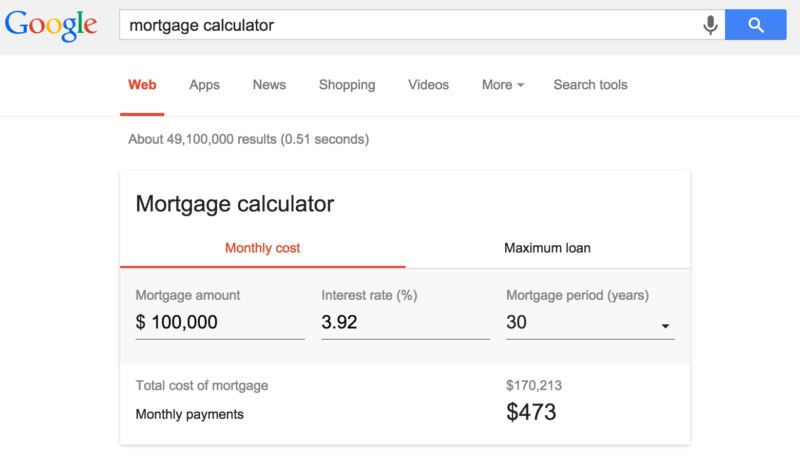
    Google has quietly launched their dynamic mortgage calculator quick direct answer in the search results for variations of queries around [mortgage calculator]. This calculator comes up for terms like [loan interest calculator], [interest calculator] and many other variations.

    Here is a screen shot of the new quick answer:

    google-mortgage-calculator

    This tool will give you the monthly cost and maximum loan cost after you type in your variables into the gray background fields.

    There are many financial sites that offer mortgage and interest calculators, so Google here figured they just give you the calculator on their own site as opposed to sending you off to a web site with a similar calculator.

    Google began testing this calculator in early December. Pete Meyers noticed it went live today.

    It would be really neat if Google took it one step further and plugged in your query into the calculator, for example [cost of 500,000 mortgage loan interest with 3.9% interest over 15 years].

    Join your peers at Search Engine Land's SMX West conference for three days of tactical sessions, keynotes and clinics on paid search, SEO, mobile search and more. Send your team and save an additional 15-35%. Register today!

    (Some images used under license from Shutterstock.com.)

    Everything you need to know about SEO, delivered every Thursday.

    Monday, February 2, 2015

    Time to panic yet? Yahoo took more U.S. search share from Google in January

    Yahoo gained more search engine market share in January, causing Google to fall below 75 percent for the first time in five years, according to the latest report from StatCounter.

    This marks the second month in a row Yahoo gained share against Google, thanks to the deal it struck to replace Google as the default search engine on Mozilla's Firefox browser.

    Last month, Google launched a campaign to show Firefox users how to switch their default search engine back to Google. But it didn't seem to slow Yahoo's momentum — at least not yet.

    "Some analysts expected Yahoo to fall in January as a result of Firefox users switching back to Google," said Aodhan Cullen, chief executive of StatCounter, an independent research firm based in Ireland, in the press release. "In fact, Yahoo has increased U.S. search share by half a percentage point."

    The news comes on the heels of a weaker-than-expected earnings report from Google last week that raised concerns about whether its core advertising business was in trouble. On a broad scale, the slip in search engine market share probably isn't having much overall impact on Google's revenues.

    But any slide will contribute to the appearance that Google, with its sprawling number of initiatives ranging from self-driving cars to floating Internet balloons to wearable computers, has perhaps taken its core business a little bit too much for granted.

    According to StatCounter, Google had 74.8 percent of U.S. search in January, with Microsoft's Bing next at 12.4 percent, and Yahoo at 10.9 percent. By comparison, Google had 75.2 percent in December, Bing had 12.5 percent, and Yahoo had 10.4 percent.

    That December figure for Yahoo was an increase from 8.6 percent before the Firefox switch in November, and is its highest tally in five years, according to StatCounter.

    It's clear that Firefox is giving Yahoo this push. StatCounter reported that use of Yahoo search within Firefox jumped from 9.9 percent in November to 28.3 percent last month.

    "When we removed Firefox usage from the U.S. search data, Yahoo's gains and Google's losses were erased," Cullen said in the press release. "This highlights the importance of the default search option and the significance of the upcoming Safari search deal for the major players."

    Indeed, while Yahoo may be a long shot to grab the Safari deal with Apple away from Google, it's likely that Apple will be getting some generous terms to renew the deal.

    Of course, it remains to be seen just how much Firefox can change the dynamic for Yahoo. Firefox's share of the browser market has fallen dramatically in recent years, as Google's Chrome browser has surged. At the moment, Firefox only accounts for 14 percent of Internet traffic, according to StatCounter, which means the upside for Yahoo will be limited.

    At the same time, Yahoo will be cheered by any sense of momentum. With pressure increasing on Yahoo chief executive Marissa Mayer to get Yahoo's core businesses growing again, the bump in search engine share offers a clear victory she can claim.

    And if the search market share increase can help rally the spirits of Yahoo employees, and get investors to step down and quiet the calls for Mayer's dismissal or a merger with AOL, then its importance could be greater than any direct financial boost it provides.

    More information:

    Google's innovative search technologies connect millions of people around the world with information every day. Founded in 1998 by Stanford Ph.D. students Larry Page and Sergey Brin, Google today is a top web property in all major glob... read more »

    Mozilla is a thriving community of intelligent, principled and passionate individuals who build software to preserve choice, openness and innovation on the Internet. As part of this mission, Mozilla develops and distributes the popular... read more »

    Yahoo! is the premier digital media company. Founded in 1994 by Stanford PhD candidates David Filo and Jerry Yang as a way for them to keep track of their personal interests on the Internet, Yahoo! has grown into a company that helps p... read more »

    Bing is a search engine that brings together the best of search and people in your social networks to help you spend less time searching. Bing is for people who do; for people like you who are always doing more. Whether online or on yo... read more »

    Powered by VBProfiles

    VentureBeat is studying social media marketing. Chime in, and we'll share the data with you.

    Sunday, February 1, 2015

    How to Find Niche Directories to Boost Your SEO

    Directories have been given a bad reputation because they're so easy to spam and they make it easy to publish poor quality content, but that doesn't mean that all directories should be off limits. The key is not to find just any directory, but find niche directories. With a little bit of know-how when it comes to finding the right directories and using them correctly, the SEO benefits can be great, even now in 2015.

    Why Niche Directories Matter

    For those who are unfamiliar, a directory is a website that includes links to many different websites so that people can stop there and navigate to different webpages. Niche directories simply refer to directories that only focus on including companies from certain niches. Below is a screenshot of AllTop, one of my favorites niche directories that caters to a lot of different niches:

    find niche directories

    The goal is to be included in a few, quality niche directories to help your visibility as well as your SEO. Think of your link on these directories as a link you might earn in a piece of content. It helps show that you're an authority and puts your website in front of the eyes of a targeted audience. Again, Google does not want you to be included in 50 general directories (this would not help your SEO), but a few quality directories is a good sign in the eyes of Google bots.

    Extra Reminder: Before you go out and try and find niche directories, make sure you do a link audit to get rid of all the links associated with poor directories. They may not have been spammy at the time, but directories tend to go sour with Google fast.

    How to Find and Analyze Niche Directories

    Below are a few tips on finding niche directories and then analyzing their quality:

    How to Find and Analyze a Niche Directory:
  • Start by researching on your own and search for some of your top keywords and then search "directory." You should have at least one page of directories that are ranking best, so analyze the first ten with some of the tips described in the next section.
  • According to this article we wrote on SEMRush, you should consider downloading SEOquake and then sorting the directories you see by links or indexed pages by clicking the "?" in the SEOquake bar.
  • After you type in a general search query, use your browser's "Find" function to search for the word directory. For Mac users simply press Apple Key +F, and for PC users press Control key +F. This will highlight which results are directories.
  • A Few Basic Analysis Tips to Remember:
  • Try to find directories with a Page Authority of at least 40. Page Authority is starting to become less and less important, but I find it still helps give a good benchmark to start.
  • You should never be asked to give a reciprocal link.
  • Good directories generally have engaging Web designs just like any other website. This means images, content, and even video. It is possible to find a quality directory without this variety of content, but most will have more happening than just a long list of links.
  • Pay attention to the dates on the directories. The more recent the better.
  • Look to see what other businesses are included in the directory. If they're spammy, keep moving no matter how good the directory might look.
  • Be prepared that for many quality directories you will have to pay a fee. Whether or not you have to pay a fee does not necessarily guarantee you've found a good directory, however, it's just something to keep in the back of your mind. There are plenty of quality directories that are free, but if you find something that asks you to pay, it's not a scam.

    Building Quality Links on Niche Directories

    When you do finally find a niche directory that you like, it's important to not only get your link on the site but also engage with the directory as much as possible. Submit an article or get involved in any comments and discussions to help bring even more visibility to your company.

    It's also worth noting that finding niche directories is important in terms of generating traffic. Some of the more general directories (though still quality) including Yahoo and DMOZ are great for link juice and visibility but not always traffic.

    What are the quality directories in your niche? Let us know in the comment section below.

    Directories photo via Shutterstock