Sunday, June 21, 2015

Leading Internet Marketing Agency iMatrix Launches New Premium SEO Service

SAN DIEGO, June 21, 2015 (GLOBE NEWSWIRE) -- iMatrix, a leading provider of websites and online marketing solutions, announced the launch of its new comprehensive Internet marketing service, Premium, on June 1, 2015. The iMatrix Premium Service provides clients with mobile-friendly website design, search engine optimization (SEO), SEO-focused custom content and increased website visibility.

As a leader in cutting-edge online marketing solutions designed to help practices and other businesses succeed, iMatrix continually provides the best possible Internet marketing services and outcomes for its clients. In fact, iMatrix launched its new Premium search engine optimization (SEO) service on June 1, 2015 in response to Google's recent search algorithm updates — namely the Panda update, which penalizes websites without custom content, and the April 21st update, which penalizes websites that are not mobile responsive.

By signing up for the new iMatrix Premium SEO service, practice owners can satisfy Google's recent algorithm updates to help improve their search ranking and increase their organic Web traffic, which often translates into increased foot traffic at their physical office location.

About Google's Algorithm Updates

The algorithm updates affect how Google ranks websites. Two of the more than 200 ranking factors included in Google's algorithm include a website's mobile accessibility and the quality of the website's content. Again, by offering mobile-friendly website designs, custom content and comprehensive SEO services, the Premium Service addresses both these updates and can help improve clients' Web visibility and their websites' search rankings.

Additional Premium Benefits

With the Premium Service, iMatrix hopes to bridge the gap between the online marketing needs of clients on the Starter or Social Service and the more comprehensive SEO needs of certain clients. Justin Allen, director of product strategy and account development for iMatrix, was particularly excited to launch this product.

"We recognize the importance of increased organic Web traffic for the overall success of any practice. Premium provides comprehensive SEO services to improve your website's accessibility, to both search engines and online visitors. This helps our clients outshine the online competition," said Justin Allen.   

About iMatrix

Founded in 2002, iMatrix provides small and medium businesses with online marketing solutions for every need and every budget. From mobile-friendly website design to advanced search engine optimization, iMatrix offers practice- and studio-based businesses a wide range of digital marketing tools and services. iMatrix is an Internet Brands company.

For more information about iMatrix or its new Premium Service, please contact Justin Allen, director of product strategy and account development, by calling 1-888-667-5236.

New iMatrix logo

(C) Copyright 2015 GlobeNewswire, Inc. All rights reserved.


Source: Leading Internet Marketing Agency iMatrix Launches New Premium SEO Service

Saturday, June 20, 2015

Link Building Requires a Targeted, Manual Promotion

Despite what some in the SEO community will say, link building really hasn't changed. Not that much anyway.

Link building is, and always has been, the manual promotion of your website to another site. This version of link building has existed since Eric Ward practically invented the trade in 1994.

My definition of link building isn't the only one out there, though. There are others who think of link building as algorithmic manipulation and spam, devoid of any real marketing purposes.

As far as I'm concerned, these tactics completely misrepresent real link building.

Skewed by Spam

I won't deny that link building has an unfortunate past. There was an arms race of spammy links to manipulate Google's algorithm, which confuses link building today with spam links of the past. For years and years, many people spammed in the name of link building.

Before Google introduced the Penguin algorithm in April 2012, spam links threatened their business model. A search engine's business (i.e. Google) is only as good as the amount of trust people put into their results. For many years, spammers were threatening the trust Google had established. Manipulating Google's algorithm meant less than ideal sites in their search results.

These tactics included everything from hiding links behind html to submitting links to article directories that no human would ever use as an actual resource.

There's an argument to be made that these practices wouldn't have existed if it weren't for Google's algorithm. At the very least, they wouldn't have been as prominent. The algorithm has always put a great emphasis on links, but it wasn't until Penguin that the algorithm could effectively discriminate a natural link from a manipulative one.

As aggressive as Penguin was, it didn't fully erase the perception of link building as spam. Not immediately anyway.

But now that we're three years removed from the first Penguin update, it's become increasingly clear that link building is still valid.

Links continue to be critical to not only organic search visibility, but the entirety of digital marketing campaigns as well. It's important to realize that link building is promotion.

Link Building is Promotion

Spammers spend their time employing manipulative tactics to game the algorithm, tactics that do nothing to better the online experience for people.

The link building I know and do is far different from this. Link builders conduct industry research, contact other webmasters within the industry, and effectively explain the value our sites provide.

When you boil it down, link building is simply online promotion.

When you build links, you have to engage with the authorities and influencers in your niche. If you want these people to link to you, you have to convince them why it's worth their while.

There are only two reasons why a site isn't linking to you:

  • They are unaware of your existence
  • They're not convinced a link to your site is necessary to their audience
  • Both of these reasons can be remedied through link building.

    In case A, the website may have never heard of you because you haven't engaged with them yet. That's okay – this is why you're building links in the first place!

    If it's case B, that's okay too. Some webmasters need convincing. It's not their job to inherently see the value in your site, pages, content, etc.

    It's your job as a link builder to explain why they should want to link to you.

    If there's a website known as a valuable platform within your industry, you should attempt to engage the people who operate it. Email them, explain the unique value proposition of your site, and why it benefits the reader of their sites. Be explicit.

    Either way, you're promoting your brand. It's not large-scale promotion, like a 30-second ad on television is. It's much more personal than that – it's direct, one-on-one contact with another important person in your industry. It's real engagement with a real human who cares about your industry much as you. This sort of relationship can lead to plenty of other marketing opportunities beyond link building as well. It's one of the reasons I love link building.

    Link Building Complements All Marketing

    Apart from building organic search visibility, link building supercharges your other marketing efforts.

    Link building may not have changed, but the online landscape surrounding it is incredibly different.

    For example, when link building was in its nascent stages, no online marketers knew what content marketing was. Today, content marketing is all anybody wants to talk about. Take a look at this chart from Google Trends:
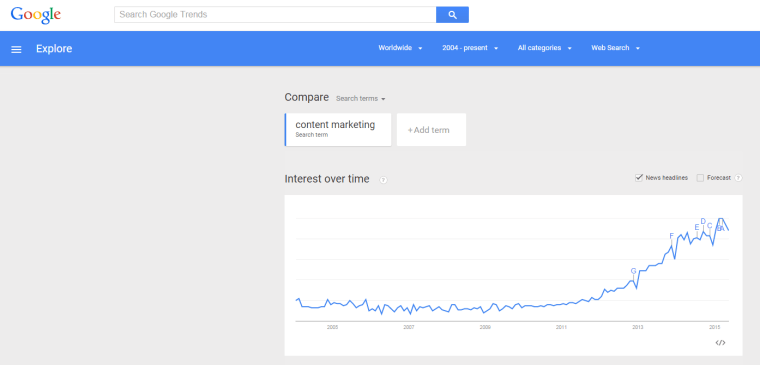
    contentmarketingtrendsScreenshot taken from Google Trends on May 16, 2015

    The noise surrounding content marketing has resulted in a lot of confusion. I can't even begin to tell you how many times we've had potential clients ask us if content marketing is what we do to secure links.

    Let me make this clear: link building and content marketing are NOT the same. They require different skill sets, and they have differing end goals.

    Although they may not be the same, the fact is that they can coincide well with each other.

    Really, link building can add to any of your online marketing campaigns.

    Maybe people don't click on your PPC ads because your brand hasn't established much visibility yet. Link building can help. Ranking in organic search will help to cultivate brand recognition.

    Maybe people aren't sharing your amazing content on social media. Link building can help here as well. Remember that the majority of traffic online is directed by search engines. The more visible your content is, the more likely people will find it and share it.

    A lack of content visibility will plague a content marketing campaign as well. Once again, link building can help with that. The goal of content marketing isn't necessarily to build links. People may be reading your content, but not linking to it. A trained link builder will take the time to effectively persuade these people to link to it, creating more opportunities for others to find you in the future.

    The point is, that no matter what online marketing strategy you're using, link building can help. You may be earning links with the other strategies, and more power to you if that's true. But for every link you earn, there are five more worth building.

    Conclusion

    Link building hasn't really changed. Legitimate link building is the same as it ever was. It's still a promotional tactic that increases your visibility in organic search. It's a practice that requires you to engage with your relevant community, and to persuade them why your site is valuable.

    Real link building isn't sitting at your computer and exhausting a series of instant submit directories. Penguin eradicated this and other spammy practices, and we should be grateful for it.

    Because of Penguin, link building doesn't have to be a dirty word. We can keep building the natural links your site deserves; the kind of links that will benefit your site and all of your other marketing efforts.


    Source: Link Building Requires a Targeted, Manual Promotion

    Friday, June 19, 2015

    5 tools to keep track of your #Keywords #Ranking position

    5 tools to keep track of your keywords ranking position Creating your website so that it is found within search engines requires a great deal of SEO. Apart from having the meta data and backlink information, the content has to be written with keywords which will help search engines find your pages. Creating a ... read moreOne Year In, Is Your SEO Effort Paying Off? Have you seen a jump in keyword position, traffic, or conversions ... the better. If you are not keeping track of your numbers and the changes you're making throughout the year, it's going to be tough to see where you want to improve. read more

    How-to Guide: 5 Ways to Use Google Webmaster Tools to Maximize Your SEO Campaign ... how certain efforts for a specific group of keywords are affecting rankings and CTR. Besides average position for the top search queries that eventually lead users to your website, Google Webmaster Tools also provides the average ranking position for ... read moreFive Best Food and Nutrition Tracking Tools Keeping track of what you eat helps you eat right and make healthier food decisions, that much is given. However, when you make the commitment to tracking ... of the other tools that want to position themselves as integral parts of your overall lifestyle. read moreDigital Fitness Plan 5. Keep it short Carl Blackwell ... By using Google's keyword tool (adwords.google.com/KeywordPlanner), a business can get on the right track without poring over their analytics. Simply drop in your website and choose your product category, which ... read moreFive Ways for Hotel Managers to Maximize their Marketing Budget You should also keep in mind your target audience when choosing which photos to feature: if you cater to couples, show photos that position yourself ... your web content so you rank higher on search engines like Google for such keywords as "hotels ... read moreRanking the Top 5 Prospects at Every Position in the 2015 NBA Draft And we've made it easy on each one by separating the top projected 2015 prospects by position ... five games, he's averaging three blocks in only 18.6 minutes, which translates to a ludicrous 18.6 percent block percentage if you're keeping track. read moreLiberty's Kevin Bush is 2015 lehighvalleylive Track and Field Coach of the Year Hurricane female athletes rank ... position football players for hurdles, sprints and jumps, your throwers would be linemen, and soccer players ran hurdles and distance." Bush said that Liberty has benefited from increased emphasis on winter track ... read more22 Free Keyword Research Tools Here is a list of tools for researching keywords. There are tools to generate keyword ideas. There are also tools to rank keywords, track searches ... to compare multiple search terms. Enter up to five topics and see how often they've been searched ... read moreChoosing YouTube or Facebook video for business Video is an excellent tool for businesses ... including: • SEO Ranking — Because YouTube is a Google product, its videos are more likely to pop up on the first page of a search result. Hosting your video on YouTube, adding a keyword rich title ... read more

    Buy AutoTrafficRSS script now for $27 only!

    We will send the script to your PayPal email within few hours,Please add FullContentRSS@gmail.com to your email contact.
    Source: 5 tools to keep track of your #Keywords #Ranking position

    Bing Updates Its Image Search For Improved Findability

    Bing has made strides lately to offer one of the most advanced image search engines on the web, and today the company announced it is making a similar effort to improve its video search.

    The video search team at Bing boasts that its new video search "makes searching easier and faster. The design changes give you the information you need to quickly pick the right videos to watch."

    It accomplishes this in 4 key ways:

  • Bigger images: An increased size of the video thumbnail in search results, offering an expanded view of the video so you can more easily pick out the one you want to watch.
  • More information: Prior to watching the video, additional information has been added to Bing's video search page such as channel, upload date, and view count.
  • "Hero" answers for songs: Searching for a song will return an enlarged thumbnail image — what Bing considers to be the "hero", for that song.
  • Related searches: Intwined in the video search results are suggestions for related searches based on your original search. These updates are built with tablets and smaller screens in mind.
  • Bing's new video search is live now. Here's a comparison of the search experience on Bing versus the search experience offered by Google when searching for the hit song "Outside" by Calvin Harris:

    bing image search

    Screenshot taken 19/6/2015 of www.bing.com/videos

    Screenshot taken 19/6/2015 of www.google.com/video

    Screenshot taken 19/6/2015 of www.google.com/video

    Image Credit: blogs.bing.com


    Source: Bing Updates Its Image Search For Improved Findability

    Thursday, June 18, 2015

    Liverpool #Ranks better on #Google than in the Premier League

    Liverpool ranks better on Google than in the Premier League Chelsea may have won the Barclays Premier League this season, but when it comes to visibility in Google UK searches, it trails its biggest rivals. A study by Searchmetrics, search and content optimisation company, analysed the online visibility of the web ... read moreRanking the 20 Best Premier League Players Available on Free Transfers This slideshow ranks the 20 best players who were ... Perhaps Davidson is not suited to Premier League football. It wasn't a fit for Borja Valero, who went on to achieve bigger and better things post-West Brom. It could be the same for Davidson. read more

    Which Premier League team has had the best strikers? We rank each side's three greatest goal-getters The Premier League has been blessed with some of sharpest of sharpshooters the game has ever seen over the last 20 or so years. But which teams have boasted the best ever in their ranks in that ... plundered 36 goals at better than a goal a game in 18 ... read moreRanking Liverpool's 10 worst signings of the 21st century Liverpool paid £18.5m for the services of Stewart Downing in the summer of 2011, with many tipping the Englishman to finally reach his potential alongside better players ... and failed to find the net in the Premier League in 2011/12, despite playing ... read moreWhy Burnley goalkeeper Heaton outperformed Hart and Green in Premier League Heaton, who was the only goalkeeper in the Premier League to feature in every minute of all 38 games, fared much better than Hart and Green in terms ... of Tottenham's Hugo Lloris in the rankings, while Liverpool's Simon Mignolet was last. read moreWales v Belgium Euro 2016 qualifier: The inside track on Belgium's Premier League stars... by the men who watch them week in, week out Belgium have soared towards the top of the FIFA world rankings with a plethora of Premier ... Lukaku's form, though, was generally better in Europe than in the Premier League. He started the campaign slowly, with critics frustrated by his poor touch ... read moreLiverpool told to pay £8m for Danny Ings Reds boss Brendan Rodgers was hoping to pay no more than ... Premier League goals this season but could not save Burnley from relegation. Liverpool do not want to pay over the odds though as they have their sights on adding a big name striker to their ranks. read moreTop 5 La Liga players who could make an impact in the Premier League Valencia's top four ranking ... Premier League survival this week. International Champions Cup 2015 live stream - Man Utd, Chelsea & Barcelona set to thrill US fans The International Champions Cup returns this July and it's bigger and better than ever ... read morePremier League cult heroes Top 10: Diego Forlan and John Jensen feature... but who else makes our countdown? That he spent eight years at Blackburn would suggest he got better with ... Spurs still ranks as one of the best goals of the Premier League era. The German was more a source of entertainment for his wacky off-the-field endeavours than he was for his ... read moreEverton & Manchester United transfer team is an impressive line-up Manchester United's Radamel Falcao has his shot blocked by Everton goalkeeper Tim Howard during the Barclays Premier League match at Goodison Park, Liverpool ... s passing style was better suited to the Blues cultured approach than the more agricultural ... read more

    Buy AutoTrafficRSS script now for $27 only!

    We will send the script to your PayPal email within few hours,Please add FullContentRSS@gmail.com to your email contact.
    Source: Liverpool #Ranks better on #Google than in the Premier League

    Deep Learning And The Future Of Search Engine Optimization

    Nathan SikesCrunch Network Contributor

    Nathan Sikes is the VP of products for Foxtailmarketing and focuses on researching and implementing practical SEO and digital marketing techniques.

    How to join the network

    The concept of deep learning or deep structured learning has been a frequent topic of conversation in recent months because of the commitment and advancements of some of the world's largest and most prolific search companies. With organizations like Google, Facebook, Microsoft and Baidu (a Chinese search engine) buying into this technology, we are starting to see a huge acceleration of the applications and uses for this relatively new artificial intelligence (AI).

    The focus of this article targets the technology of deep learning and its influence on search engine optimization (SEO) in today's online world. Let's take a look at what deep learning is, some history and some of the major players who are using this AI to shape and improve the digital landscape around us.

    The Quest For Real Artificial Intelligence

    Before we can truly grasp the implications of deep learning, we need to better understand what it is and where it came from. Although you can't track its origins to one particular person or place, most authorities in the field agree that Geoffrey Hinton is the godfather of modern-day deep learning. Currently splitting his time between Google and the University of Toronto, Hinton's contribution to Backpropagation in the 1980s, and most recently the Neural Computation and Adaptive Perception Program, has re-ignited a flat industry in need of a spark. "Over the last 20 to 30 years, he [Hinton] has been pushing forward the frontier of neural networks and deep learning," says Kai Yu, the director of Baidu's Institute of Deep Learning. "We have never seen machine learning or artificial intelligence technologies so quickly make an impact in industry. It's very impressive."

    Many companies are seeing that the future of deep learning is here, and that it doesn't require a lot of money or resources to take advantage of this new industrial science.

    Hinton's contributions can be tracked to almost every large entity currently working on artificial neural networks and deep learning. Yann LeCun, currently at Facebook, helped develop Backpropagation alongside Hinton in the 1980s. Andrew Ng, the Chief Scientist at Baidu, founded the Deep Learning Project at Google in addition to working there with Hinton for years. Although these handful of engineers may be working for competing companies, they're all desperately in search of the same thing — real behavioral learning in artificial intelligence.

    Previous to the last decade, the business industry had all but turned its back on the field of deep learning. The limitations of chip-processing abilities and the data sets used in the artificial neural networks that ran them made Hinton's and his colleagues' theories impractical and ahead of their time.

    Fast forward to 2015 and we see a completely new environment full of potential applications, and the big boys aren't the only ones who noticed. Smaller organizations like Clarifai are using augmented intelligence for advertising, moderation/filtering and content curation purposes. Other companies like Moz (an SEO company) also see this as the future, and a way to provide better products and services to their customers.  "A lot of technology firms like Moz do some level of machine learning. We don't do anything with deep learning and a lot of neural networks. We might be going that direction," Rand Fishkin explains on the Moz blog.

    Many companies are seeing that the future of deep learning is here, and that it doesn't require a lot of money or resources to take advantage of this new industrial science. IBM's Watson Analytics offers a freemium service that allows you to upload up to 500MB, and enables you to explore your own real-life applications for deep learning. Inputting Google Adwords or other sales metrics into this tool can help even startup companies find relational and predictive information in their data. In addition to Watson Analytics, let's take a look at the other companies developing and using these technologies right now.

    Google Research: Google ranks third on Forbes' list of "The World's Most Valuable Brands In 2015," but I don't think many would argue that they're first in search. Google has made many advancements over the past decade when it comes to machine intelligence, and has been working on building a better understanding of images, videos and language.

    Through their research, acquisitions (think DeepMind, acquired in 2014) and partnerships like the one with Imagenet Large Scale Visual Recognition Challenge, Google has remained committed to testing and applying new areas of deep learning. Most recently, Google announced they now have the ability to automatically produce captions and describe images the very first time they see them. Can you imagine if image recognition or features like this were implemented within Google's search algorithm?

    It may not be that far off. Geoffrey Hinton explains in a Reddit Ask Me Anything session, "I think that the most exciting areas over the next five years will be really understanding videos and text. I will be disappointed if in five years time if we do not have something that can watch a YouTube video and tell a story about what happened."

    Facebook FAIR: The most popular social networking site in the world has become a strong player in search, and will continue to grow their market share in the years to come. Facebook AI Research (FAIR) shows Facebook's commitment to artificial intelligence and deep learning as the future of social, purchasing and media. In fact, one could argue that between their facial recognition software, their contribution to open source modules for Torch (a development environment for deep learning) and the most recent announcement by Mike Schroepfer (their CIO) stating that Facebook's AI now has the ability to recognize actions in video, Facebook is the current leader in utilizing deep learning intelligence.

    Microsoft Project Oxford: Microsoft recently made waves with their how-old.net facial recognition project. What most people don't realize, however, is that this undertaking was designed by Microsoft's machine learning research team. In fact, according to Microsoft's blog, "It took a couple of developers just a day to put this whole solution together, from the web page to the Machine Learning APIs to the real time streaming analytics." And that's only the beginning. In addition to projects like this, we will also surely see an integration of Project Oxford and Cortana (Microsoft's "personal assistant") into Windows 10 and Edge, the Internet Explorer replacement.

    WolframAlpha: WolframAlpha isn't a household name — yet — but has been a big player in the artificial intelligence industry for the last several years. Their ultimate goal is to compute anything and everything, but they focus primarily on fields that require expert-level knowledge or capabilities. Recently they've expanded their reach to image identification, problem generators, language recognition and even analytics for Facebook.

    So Why Should I Care?

    We have finally passed the threshold of if artificial intelligence will be integrated into the search to when it will be, and the companies mentioned above are leading the charge. So given this new information, what kind of impact will deep learning really have on search over the next five years? Here are a few predictions:

    New SEO verticals: If you're an online marketer and this technology doesn't get you excited…you may be in the wrong field. This type of artificial intelligence offers search engine marketers a chance to take advantage of a variety of new channels, including image-heavy social networking sites, video-sharing sites and even slide presentation platforms, while getting "credit" for images and videos that bring value to searchers.

    It's becoming increasingly more important to capture your customer's imagination and attention with visuals, and search companies are taking notice.

    Death of the spam site: Google has been working on fighting spam sites for a long time. They even have an algorithm called Penguin that is dedicated to decreasing the rankings of sites that use spam tactics. My prediction is that we will see a huge decrease in websites that use spammy techniques, sneaky redirects or have thin content with no value. This will provide a safer, less cluttered web.

    Better device integration: Google's mobilegeddon update wasn't the last of its kind. As companies like Facebook (Oculus) and Microsoft (Hololens) put out their virtual reality headsets, we are going to need a smarter search engine that has the ability to prioritize and learn what websites should be displaying on which devices.

    No place to hide: As search engine companies perfect this AI and become more intelligent, so will their tracking capabilities. We are going to see a new generation of "supercookies" like the ones Verizon, AT&T and Facebook have recently released, which is going to make it increasingly more difficult to stay hidden online.

    Visual content will be more important than ever: Millennials ignore ads on a greater level than any other generation before them. According to Simply Measured (a social media analytics company), 62 percent of all brand posts and 77 percent of all produced engagements on Facebook are photos, as opposed to just normal text. To go even deeper, Hubspot's research says that you can generate up to 94 percent more views and 37 percent more engagement if you add compelling visual elements and graphics to blog posts and social media content.

    It is becoming increasingly more important to capture your customer's imagination and attention with visuals, and search companies are taking notice. Look for this type of content to be prioritized in the future.

    Featured Image: NeydtStock/Shutterstock
    Source: Deep Learning And The Future Of Search Engine Optimization

    Wednesday, June 17, 2015

    How to Use Buyer Personas & CTAs in Content Marketing: Insights From #SEJSummit Speaker Marla Johnson

    Marla Johnson is no stranger to marketing development and strategy. She's the CEO and founder of Aristotle, Inc., an interactive marketing agency that has been a driver in the industry for more than 20 years. We are honored for her to be a part of SEJ Summit Silicon Valley, our San Francisco-area marketing conference being held on July 22nd in Mountain View.

    Marla's SEJ Summit topic is Message in a Digital Bottle: Finding the Right Audience, in which she will discuss "audience segmentation and content marketing strategies, giving you tools that help your message find the right people at the right time".

    If you'd like to learn from Marla and our other great speakers, we still have some FREE tickets available for our Silicon Valley event.

    The SEJ Summit series is possible courtesy of our partner, Searchmetrics. Their "search experience optimization" makes digital marketing better, faster, and more profitable.

    Request an invite today here.

    Here's my interview with Marla:

    1. With so much noise online, what is the number one thing a brand can take to get their content to stand out?

    Relevance. Find your audience and make your messages relevant. If you can, also make your messages connect emotionally through video, music, engaging content, and photography; that's when you're going to win the day with the one-two punch. But first, the content has to be helpful and useful and have some connection to consumers.

    The great news is because we have a global marketplace on the Internet, we can find those consumers and get our messages to them with segmentation technologies.

    2. We hear a lot about using buyer personas to aid in targeting content during development. Do you think developing buyer personas are effective for most brands?

    Yes, I do. Throwing your message in a bottle into the ocean is not going to guarantee you'll find your true love. You'll be better off if you know something about the people who will buy your product. And by focusing on the buyer persona, you focus on where the buyer is in the buying cycle, what they need at that point, how you can provide it, and what their user experience is. It's really important in the long run, too, because whether or not it's easy for consumers to get the information they need to buy your product online has an impact on your brand image.

    3. In your presentation, you will cover the importance of CTAs. Can you give us one tip for developing an awesome CTA?

    Big and buttony! Don't be shy! Never assume people know what it is you want them to do. They don't. Ask for the business.

    4. There has been a huge shift toward developing quality content over quantity, which most brands have embraced. Where do you think most brands are still missing the mark in regard to content marketing?

    Brands are challenged by the need to create new content over and over again. Consistently putting out quality content is labor intensive; it requires that the marketer plan ahead and calendar content so it is seasonally relevant, and assign accountability for content development. Having so many content channels, including search, social, email, video, ads, blogs, and web, adds to the demand. Creating the messages year round and making sure they're appropriate in each of those channels is just a big job!

    5. You hold a Master's degree in Education from University of Arkansas at Little Rock. How has your background in education has informed your approach to digital marketing?

    Because digital marketing is changing all the time, I am teaching all the time. I'm explaining how things work to people who aren't accustomed to our digital marketing lexicon. Also, as a marketer, it's been very beneficial for me to understand there are different styles of learning. Creating user experiences that work for people who learn differently and categorize information differently has been really helpful to me in overseeing content development.

    Thanks so much Marla! As a writer, I love the emphasis on content in marketing these past few years.

    Don't forget, you can request your free ticket for our SEJ Summit Silicon Valley /San Francisco marketing conference, taking place July 22nd at The Computer History Museum in Mountain View, California. You can also come see us in NYC (where I'll be acting as host) and Atlanta later this year.

    Featured Image: StudioIcon via Shutterstock


    Source: How to Use Buyer Personas & CTAs in Content Marketing: Insights From #SEJSummit Speaker Marla Johnson