
Buy AutoTrafficRSS script now for $27 only!
We will send the script to your PayPal email within few hours,Please add FullContentRSS@gmail.com to your email contact.Source: 5 Overlooked #SEO Opportunities to Take Advantage of Right Now
Buy AutoTrafficRSS script now for $27 only!
We will send the script to your PayPal email within few hours,Please add FullContentRSS@gmail.com to your email contact.
Content marketing lies at the intersection of art and technology, so it's only logical that artificial intelligence comes into play. AI plays a big role in search and it can be useful in creating content, too.
While it's not known exactly how the Google algorithm works, researchers and marketers have conducted experiments that make a strong argument for topic modeling as a key component of the Hummingbird algorithm. Also, Wired reported last year about how Google's search engine now uses artificial intelligence to rank content.
Google's search engine now uses #artificialintelligence to rank #content via @wired. Click To TweetA basic understanding of how search engines interpret text and its quality can help you develop a strategy that produces consistently high-ranking content because topic modeling – done manually or with software – allows you to create blueprints for the best possible content.
In this post, I explore the concept of topic modeling and how it relates to search algorithms. Then, I'll go over some key strategies on how to develop your content to include all relevant topics, and how you can take advantage of topic model predictions to outperform the competition.
First, let's dive into what exactly topic modeling is and how search algorithms can use it to rank the billions of pages on the web.
HANDPICKED RELATED CONTENT:
What is topic modeling?Words and phrases are interrelated, and the idea behind topic modeling is to discover those relationships. When crawling your content, search engines aren't just crawling for specific words, they're seeking words with related meaning. This makes keywords, keyword variants, and related topics an integral part of creating contextually rich content. The placement and frequency of each keyword should correlate with how important that term is to your piece.
Search engines don't just crawl for specific words. They seek words w/ related meaning. @rakkenbakken #SEO Click To TweetWhen thinking about which topics to cover in your content, it helps to think in terms of searcher intent. What questions could your reader possibly have about this topic, and how can you answer them comprehensively? When you achieve this, your content signals to Google's AI that you're the authority on that subject – a major factor in ranking.
A note on keyword tools versus topic modeling: It's true many tools can generate lists of "related keywords," but there's a difference in the technology behind keyword tools and topic-modeling software. Keyword tools primarily look at topics that appear together in high-ranking pages and group them together. They don't look at the number of co-occurrences between terms, semantic relevance, and other signals, so they're not necessarily informing on the degree to which topics are related. Conversely, AI software can perform this calculation and rank related topics by importance, while taking other on-page factors into account as well.
How to manually create a topic modelLet's walk through the steps you would follow to manually implement topic modelling for your website.
1. Inventory each page on your site.To stay organized, keep a spreadsheet. Every URL should have a row, and columns should indicate these points:
(Sorting in spreadsheets requires uniform inputs. Identify your target focus topics, a scale for quality, and user intents ahead of time.)
2. Identify gaps in topic coverage.Once you've done this for each page, look at your focus topic column and see which topics are covered in depth, and which have gaps. For the topics with gaps, plan to create new content to cover them.
3. Prioritize pages to update.For pages you've identified that need improvement, identify the subjects related to your focus topic that need to be added. URLs with the most shallow topic coverage should take priority, particularly if their focus topic is important to your business.
The rest is a matter of execution for your content team. You can help them by creating blueprints that detail the ideal word count (based on pages ranking for your focus topic), related topics, and user intent profile for each post. For any piece of content you create, follow this basic framework:
On-page factors
Each page on your site should have a framework that signals to search engines what topics your site covers. These on-page signals are important for SEO, and can provide guidance to make your content creation process more efficient:
Framework for every site page should signal to search engines what topics are addressed. @rakkenbakken #SEO Click To TweetA less visible factor to consider is whether your content answers your users' questions. This is key as search engines favor content that directly responds to queries. Think about the questions your visitors might be asking and provide a thorough answer.
Writing content that speaks to searcher intent thoroughly will get you far, but it really helps to have some tools at your disposal.
HANDPICKED RELATED CONTENT:
Automate the processAdvanced artificial intelligence platforms such as MarketMuse (disclosure: a client and a platform that I use successfully) are available to find topical gaps in your content, identify related topics, and generate outlines and keyword lists to guide you to topical authority. Creating and updating content is much easier when you give your team clear-cut, data-based recommendations in an outline. Alternatively, you could pull organic keyword data from SEMrush and use Excel to filter and analyze it to give you a list of terms for which top content is ranking (i.e., topics you should cover with your own content).
AI solutions can remove a lot of the guesswork when deciding which topics to cover, and because they use technology similarly to the way search engines do, they provide data that produces predictably positive results.
Many content marketers will be satisfied with the information already covered. But if you're one of those next-level, data-obsessed marketers, read on.
Going more in depth for data geeksThere are several different types of topic models, and, for most marketers, it's not terribly important to know the minutiae of each one. In general, a topic model is a text-mining method that determines the relevance within a body of text. Topic modeling allows algorithms to analyze vast amounts of web content, assigning topical relevancy to each page and ranking it efficiently and accurately with each query.
A topic model is a text-mining method that determines the relevance within a body of text, says @rakkenbakken. Click To TweetAdditionally, it allows for advanced content analysis and search engine optimization software to identify topical gaps in content. When you understand how topic modeling works, you're better able to plan your content and effectively use the tools at your disposal.
One of the more common topic models for identifying topical probability is latent Dirichlet allocation (LDA), a statistical model in natural language processing. An LDA model views individual documents within a corpus – or, in search terms, pages within a site – and determines the relevancy of each page to a topic, assigning a percentage for topics mentioned. Here's a simplified example:
Page 1: There are many delicious vegetarian dishes.
Page 2: A vegetarian diet contributes to a healthy lifestyle.
Page 3: Julia Child was one of the first TV chefs.
Page 4: Julia Child cooked many types of vegetarian dishes.
Pages 1 and 2: 100% topic A
Pages 3: 100% topic B
Page 4: 50% topic A and 50% topic B
Using an LDA model, a software platform would be able to infer that the site as a whole is about vegetarian cooking, which also discusses some famous chefs who cook vegetarian recipes. One characteristic of LDA modeling is that a topic isn't defined as a single thing, but rather a group of related terms.
For instance, topic A in this example would include vegetarian dishes, vegetarian cooking, vegetables, and so on. Topic B would include Julia Child, famous chefs, TV chefs, etc. Having groups of terms within each topic means that search engines can more intuitively pull pages related to a query, even if the person did not search for that exact term, giving the searcher the greatest number of relevant results.
LDA isn't the only type of topic modeling, however. If you're interested in taking a deep dive, here are some other topic models to consider:
Additionally, databases such as Google's Knowledge Graph and techniques such as TF-IDF (term frequency and inverse document frequency; a much more simple method than LDA), co-occurrences, and co-citations all use topic modeling to determine semantic meaning of a body of text.
It's not necessary to have an intimate knowledge of topic modeling to create a successful content marketing strategy. But knowing how search algorithms categorize pages is useful when deciding which topics to cover, the pages on which they should be mentioned, and how frequently you should write about your core and secondary topics.
ConclusionTopic modeling plays a significant role in planning and search, in both obvious and subtle ways. Now that you have a basic understanding of how topic models work and how they're applied to content, it should help you plan and organize your content in a way that puts topics – not keywords – at the forefront of your content marketing strategy.
Please note: All tools included in our blog posts are suggested by authors, not the CMI editorial team. No one post can provide all relevant tools in the space. Feel free to include additional tools in the comments (from your company or ones that you have used).
Sign up for our weekly Content Strategy for Marketers e-newsletter, which features exclusive stories and insights from CMI Chief Content Adviser Robert Rose.
Cover image by Wilfred Ivan, StockSnap

Buy AutoTrafficRSS script now for $27 only!
We will send the script to your PayPal email within few hours,Please add FullContentRSS@gmail.com to your email contact.Marketing to developers is tricky - you need to understand their language (jargon), preferences, and motivations. It's no easy feat!
So when I heard that Evan's Data was organizing the first ever Developer Marketing Summit, I was like, "Woohoo! A chance to learn about developer marketing practices and mingle with marketers who are facing the exact same challenges as me!"
The Developer Marketing Summit was September 19-20 at the Crowne Plaza in Burlingame, CA (just outside San Francisco).
The speaker line-up included: Catherine Solazzo at IBM, Gretchen O'Hara at Microsoft, Desiree Motamedi at Facebook, Gina Poole at Amazon, and many, many more. Sessions covered topics like 10 ways to do developer marketing right, marketing to game developers, how to evolve your developer ecosystem, and reaching developers through advertising.
Below are some of the key takeaways from the conference. (And sorry for the bad slide pictures!)
1. Go where the developers areYou know the phrase "If you build it, they will come"? Well, unfortunately for us, that does not apply to developers.
We need to actively seek developers out - on the channels they frequent most - to get them to notice our software, platforms, tools, company, etc.
Where do developers hang out? Events and... well, online.
Events: Conferences, Tradeshows, and Hackathons
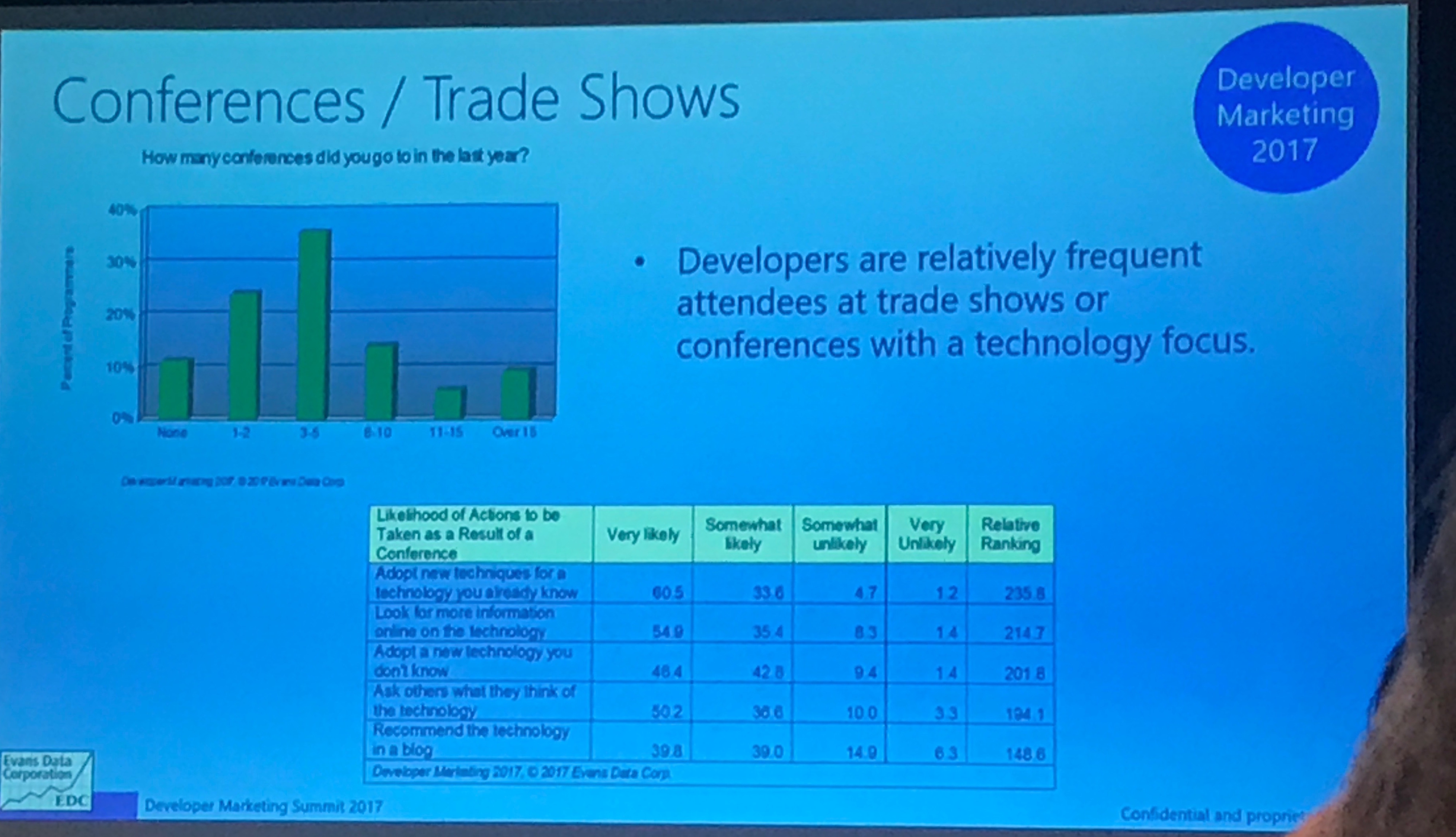
Developers love events. In fact in Evan's Data's Developer Marketing 2017 research, just over 30% of developers said they attend 3-5 conferences or trade shows each year. And are also more inclined to adopt a technology they already know AND some they don't know just from attending.
During the Developer Marketing Best Practices Panel, all three panelists (Suzanne Nguyen from Samsung, Uzair Siddiqui from Verizon, Stephen Donnelly from Accenture) all said events were their favorite way to engage with developers.
They said interacting with developers face-to-face, whether that be at lunch 'n' learns, hackathons, conferences, or workshops, allows them to see how developers use their solutions.
Their favorite events? The Samsung Developer Conference, Geeks Who Speak (London), and small (30-40 people) workshops.
Online: Websites, Social Media, and Paid Advertising
Developers are digital creatures, spending a majority of their time online.
Where on the web do they hang out? Stack Overflow, Hackernews, DZone, and social media sites.
Evan's Data's research states that developers believe tech platforms (like DZone) and vendor websites are the most credible sources of information.
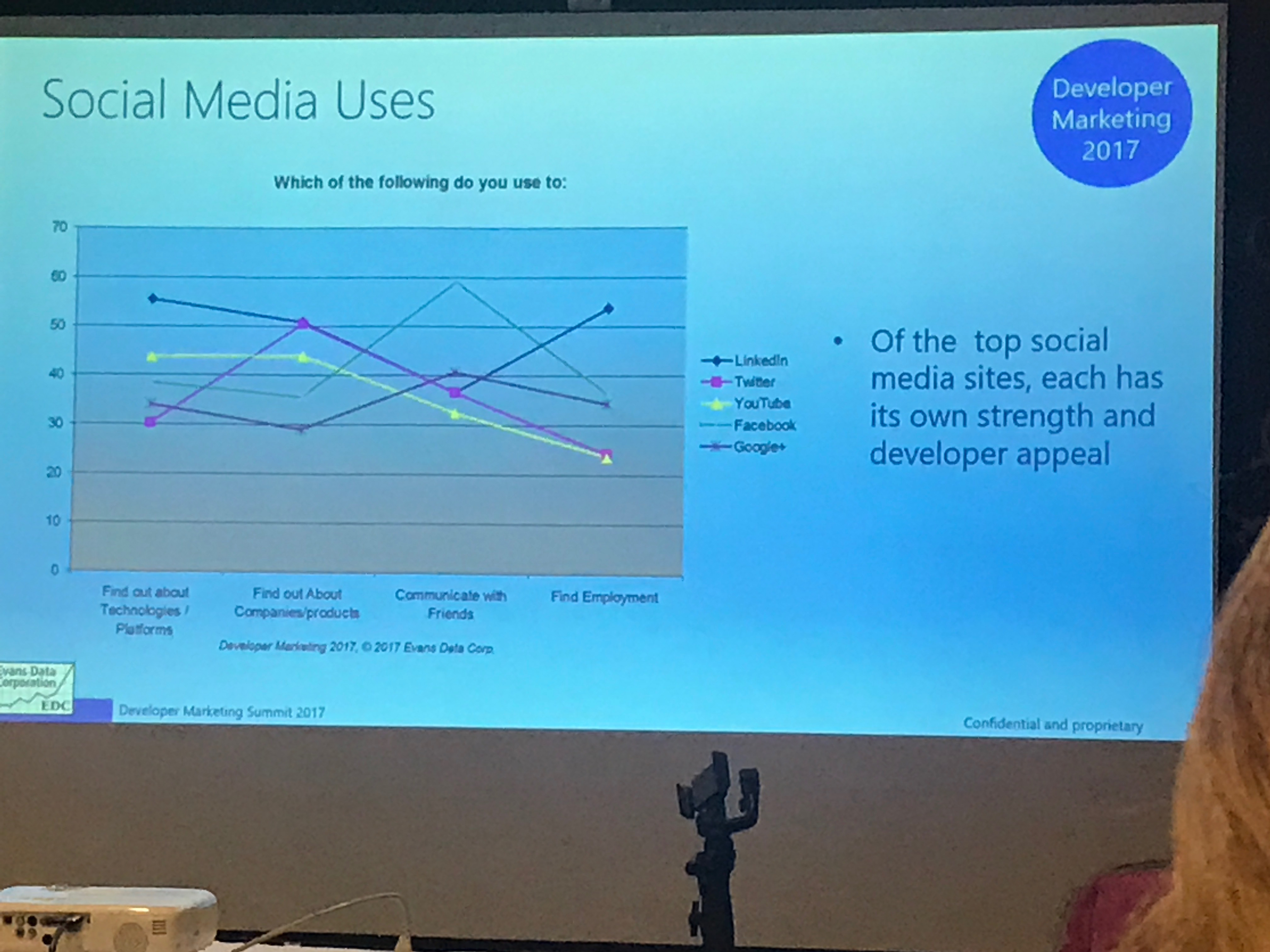
Their research also says that devs use social media sites to learn more about new technologies, research companies, and find jobs.
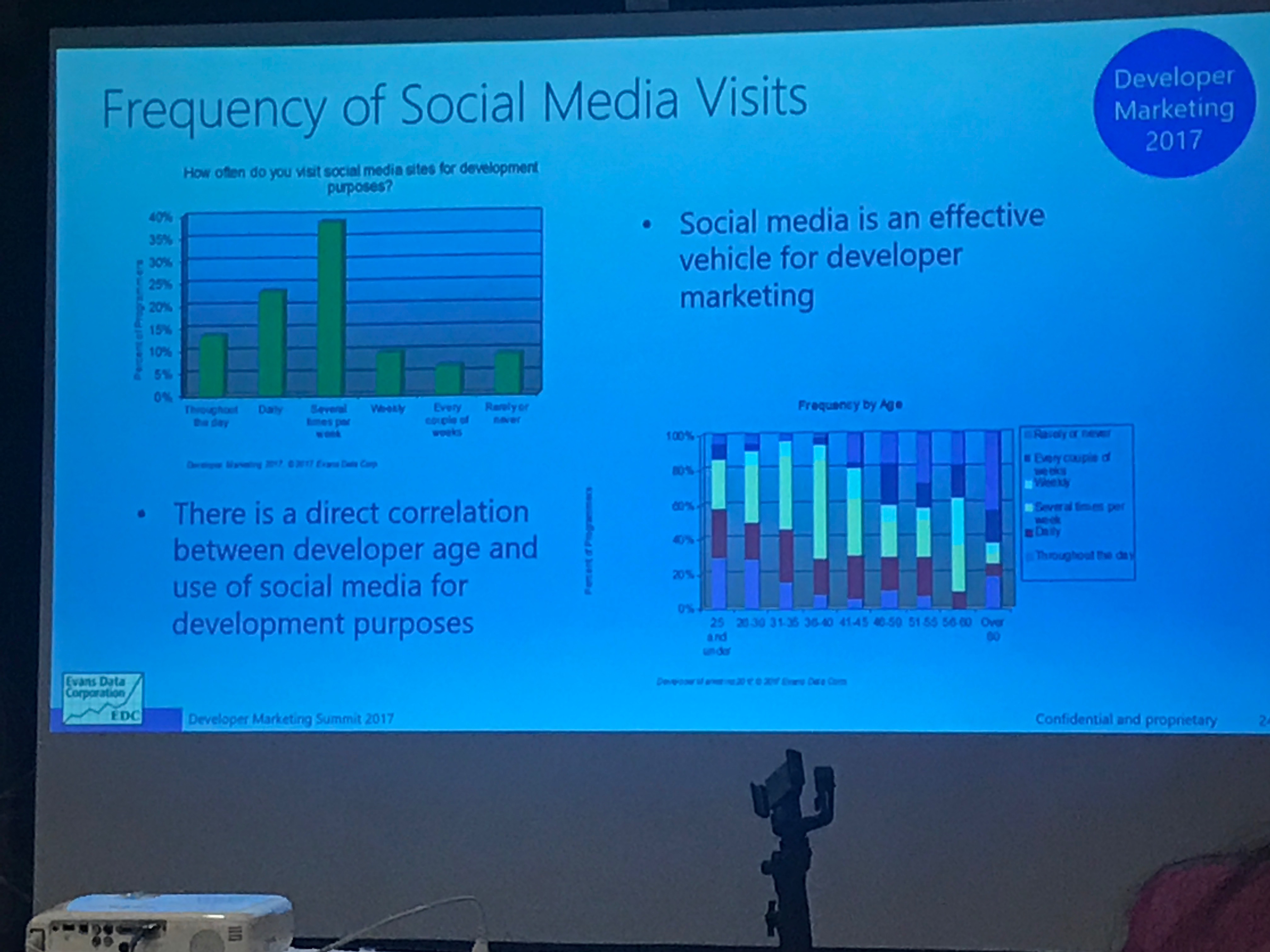
And that they visit these social channels pretty frequently, with almost 40% saying they visit several times a week.
Another way to be where the developer are: paid advertising.
And I don't mean on tech websites. I mean Google AdWords, Bing Ads, and social media ads.
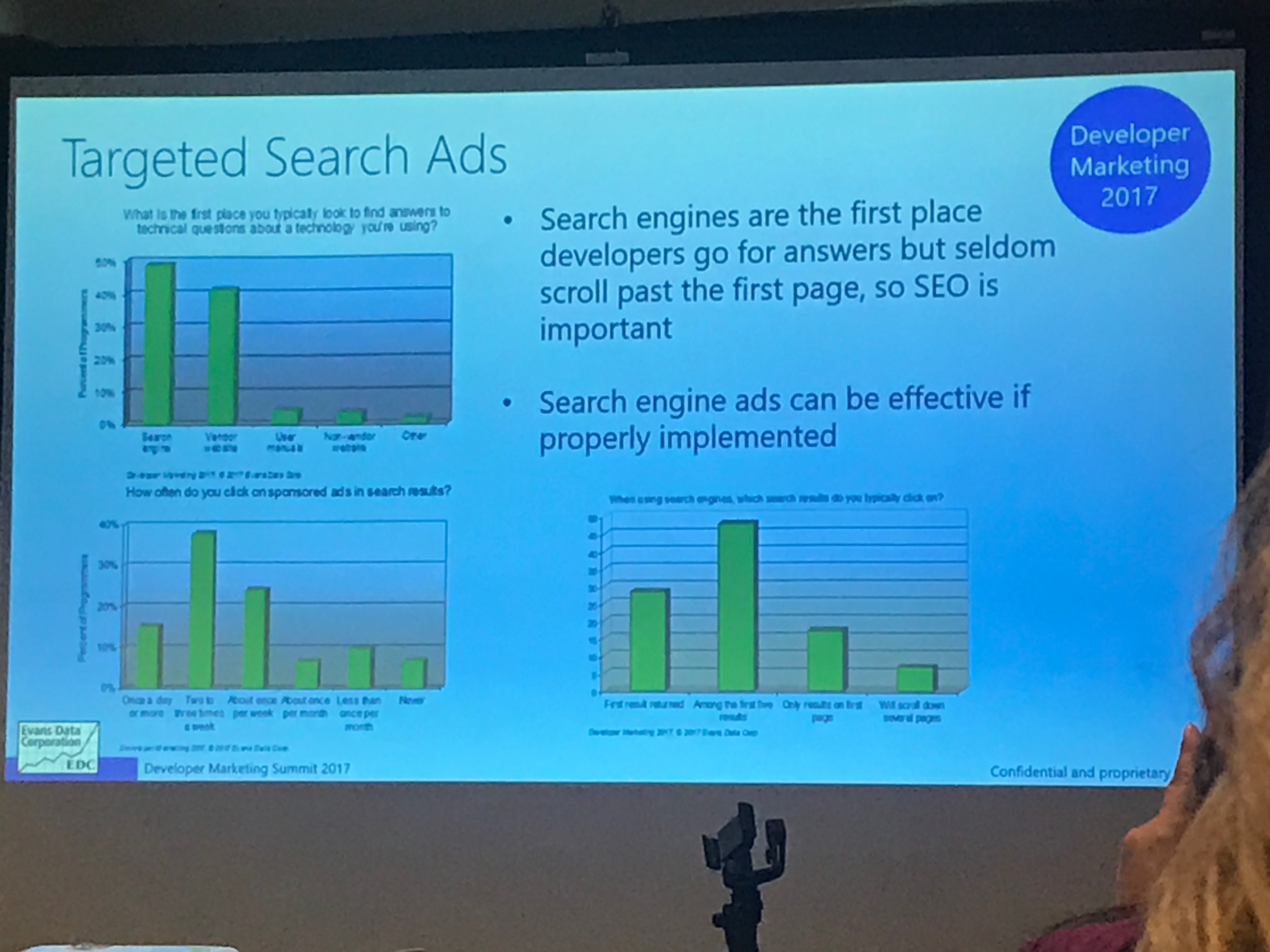
Search engines are the first place developers go when they are looking for answers, so appearing at the top of the search results with paid ads can be an effective way to get noticed. Just about 40% of developers said they clicked on several sponsored posts several times a week when searching online.
This also means that SEO should absolutely be a part of your marketing plan. Developers are not going to scroll through dozens of pages to find the right solution.
Getting found on page one of the SERPs organically and with a highly targeted paid ad can really improve your online marketing success.
Takeaway: Put yourself directly in front of developers - in the places where they hang out the most!
2. Developers are people too!It's really easy to forget that developers are just like you and me: consumers of products.
I feel we often think of them as programmers who sit in dark caves, hate all forms of advertising and marketing, and dislike interacting with people. But this is so far from the truth!
Developers enjoy talking to other people, using social media, and collaborating on projects.
And they also enjoy giving back!

For younger developers, money and security are not their primary motivating factors. They are more motivated by giving back to charity. And would be more willing to donate their time than older developers.
Takeaway: Know your audience! Understand their motivations, preferences, and likes so you can create compelling messaging.
3. Be creative! Have fun!Marketing is supposed to be fun, right? Well, why is it when we start marketing to developers, our messaging and creatives get boring and generic.
While developers don't like traditional marketing tactics, they still appreciate fun and creativity.
Knowing your target audience (their likes, motivations, etc.) will help you create clever and compelling marketing copy.
IBM-er Catherine Solazzo shared this email sent to get developers interested in their Blockchain Platform. She pointed out that the email is not pushy, uses jargon that developers understand, and shares technical resources to help them get started.

Another example is this email DZone sent regarding Microservices.

The email shares resources to help developers learn and build microservice architectures, using a marathon theme to take them from beginner to expert.

Email isn't the only place to let your creativity run free. Inject some fun into your landing pages, banner ads, blogs, social media posts, and eBooks.
Takeaway: Let your creativity fly!
--
The Developer Marketing Summit was a great conference - lots of useful information and actionable tips for running marketing campaigns to developers. We're already looking forward to next year's event!
Want more developer marketing insights? Subscribe to the Developer Marketing newsletter and receive the latest updates delivered right to your inbox.
Today, there is no need to talk about the benefits of Voice Search technology. It has already spread to many different spheres of life.
Source: neiphone.com
According to Google, one in every five searches made with the Google Android App in the United States is a voice search.
For example, in everyday life, people use Voice Search to order pizza, and children look for their favorite cartoons with the help of this technology.
In the world of business, enterprises use Voice Search to increase the customer experience and their profit gains.
In fact, time does not stand still, as technology is continually creating new challenges for all who want to successfully use it.
If an enterprise can adapt to these Voice Search challenges, it will be substantially ahead of those who do not.
In this article, we will take a closer look at Voice Search technology and discuss how it changes with time.
We will also discuss what challenges an enterprise can have in connection with the evolution of Voice Search and how to cope with them.
What Is Voice Search and Why It Is Important?Voice Search is a technology that allows the user to use a voice command to search the Internet.
What is so special about it?
There are several points:
According to a Mobile Voice survey, today, 55% of teens and 41% of adults use Voice Search more than once a day.
This allows us to say with confidence that the technology is appealing to customers of all generations and ages.
Thus, Voice Search opens up great prospects for its use in any business.
It is interesting that the more companies take on Voice Search technology, the more it begins to change the rules of the game.
For example, many experts note that the technology radically changes the way in which SEO works.

Source: pexels.com
Some time ago Neil Patel, a marketing guru and entrepreneur, said that Voice Search would affect SEO..
Aleh Barysevich, Founder and CMO at Link-Assistant.Com, agrees with Neil, "Voice Search Will Forever Change SEO."
In particular, experts say that it's time to reduce the use of short tail keywords and focus on long tail keywords.
The thing is that content should be more conversational in order to be found through Voice Search, and short tail keywords make it less relevant.
As a result, the very essence of business begins to change under the influence of Voice Search.
Statistics and opinions of experts make it clear that the technology is developing rapidly.
This means that we should expect even more of its influence on the world around us.
Two years ago the percentage of errors in the voice recognition of human speech was 20. Now, the percentage of errors has dropped to 5.1%.
It's amazing that this is equal to the human error rate.
Even compared to other types of search – i.e., Visual Search, Image Search or Video Search – Voice Search technology is surpassing them on the speed of its progress.

Source: pexels.com
According to Behshad Behzadi, Principal Engineer at Google Zurich, Voice Search is the fastest growing type of search.
Why Every Enterprise Should Be Ready to Meet Voice Search ChallengesLet's discuss why it is important for any enterprise to be able to handle Voice Search technology and how it develops and changes business.
Because Voice Search will allow a business to remain competitive and increase its customer retention rate
An enterprise that knows how to work with Voice Search and actively utilizes it will always be ahead of less prompt and innovative companies.
Many surveys confirm this idea.
The results of a Geomarketing study are particularly interesting: 42% of respondents said that voice-activated devices are "essential" to their lives.
So, if these people have a choice between an enterprise that allows customers to search for information via Voice Search and an enterprise that uses older technologies, it is obvious to whom they will turn.
The reason why Voice Search conquers the hearts of so many people is simple—it's very convenient.
2016 Internet Trends Report by Kleiner Perkins Caufield Byers confirms that Voice Search improves the customer experience.
Therefore, we can conclude that an enterprise's ability to properly handle Voice Search technology is an invaluable competitive advantage.
Because Voice Search is a way to attract many new customers
The number of people who use Voice Search for searching is growing, and these people will naturally go to the company that offers the best customer experience.

Recommended for You
Webcast, October 19th: Triple Your Revenue Through Event Marketing
Source: pixabay.com
Google says that, as of a year ago, over 20% of searches on mobile apps and Android devices were performed via voice searches.
This number is steadily growing.
ComScore predicts that by 2020, a full 50% of all searches will be by voice.
Thus, an enterprise that is familiar with the voice search technology will continuously expand its customer base without much effort.
Which Voice Search Challenges Enterprises Must OvercomeLet's discuss the impacts of Voice Search and how modern enterprises should adapt to this technology.
1. Integration of structural data
The development of newer technology has led to the fact that business websites must undergo some changes.
In particular, Christi Olson, search evangelist, says that enterprise specialists should incorporate structured data (schema markup) into the backend of their website.
He believes that, "Structured data within your website becomes more important because it is one of the signals used to power the search results and the "cards" — or direct answers."
As a result, structured data and schema markup make search engines better understand and process website data.
This will allow the program to enhance its understanding of the information given on the website. As a result, the website will become more relevant.
2. Employment of new strategies for local Voice Search
This point is of particular importance for E-commerce enterprises or for those that want to be easily found on local requests.
Part of the change in local Voice Search appears to be due to the growing influence of Amazon and the spread of its Echo smart speakers.

Source: brunch.co.kr
Already in the first quarter of 2016, Amazon shipped almost one million Echos; this is twice as much as Apple's 50 million iPhone sales.
Echo search algorithms are based on so-called 'skills' (the equivalent of apps) so that Echo can process the data and give relevant results.
Wesley Young, the Local Search Association's Vice President of Public Affairs, explains, "For example, the Echo utilizes Yelp's database for local service providers, retail and restaurants, as well as reviews in ranking and formulating its responses."
Also, he says that as more skills are incorporated into Echo, it becomes more complex for any business to optimize its profile and stand out among all the various sources of information.
The number of 'skills' is continually growing – it already exceeds 1,000.
So, what happens if the enterprise website is not optimized for the 'skills' algorithm?
"The Echo defaults to Bing for any general search query that is not covered by a skill, but that search experience is also relatively poor in its current form," says Wesley Young.
3. Adapting to new customer approaches to phrase queries
Over time, the manner in which customers use Voice Search has changed and will continue to change.
For example, instead of pronouncing key phrases, now people prefer to say complete and long sentences.
Now it is up to enterprises to decide whether they want to stay relevant or continue to rely on the old search algorithms.
Jim Yu, founder and CEO of BrightEdge, believes that "When considering the rise of voice search, you cannot neglect to consider the shift in Google's algorithm. The search engine has moved away from helping consumers find an answer to your query to just providing you with the answer itself."
Moreover, experts admit that as customer requests become more conversational, they also become more nuanced.

Source: pexels.com
For example, an earlier user used to say "Cheap pizzeria near me," but now he would rather say "I want to eat tasty and cheap pizza in 15 minutes."
All these changes need to be taken into account.
"The rich answers provided by Google will play an important role in voice search. The ability of brands to optimize and get their sites featured in these answers will dictate their visibility for a growing number of users," concludes Jim Yu.
ConclusionsEnterprises need to adapt to Voice Search changes to move ahead of competitors instead of remaining behind in the pursuit of customers.
After all, customers will always choose a more progressive enterprise that understands their needs and increases the convenience of its customers with the help of new technologies.
Voice Search is a technology that allows the user to perform a voice command to search the Internet via a portable or stationary device.
The technology is now very prevalent. It has a powerful effect on business, and its impact is steadily increasing.
Voice Search is continuously evolving.
Enterprises should be ready to meet Voice Search challenges because it will allow them to remain competitive and increase their customer retention rate.
Do you use Voice Search technology in your company? If so, how do you handle new Voice Search challenges? Please, share your thoughts in the comments.
 Author: Hassan Bawab
Hassan Bawab is the founder and CEO of Magic Logix, a Dallas, Texas based agency that provides a full spectrum of digital marketing and web development services for our worldwide clients from a variety of industries. After the successful launch of Magic Logix in 2004, Mr. Bawab's entrepreneurial ambition continued.… View full profile ›

Buy AutoTrafficRSS script now for $27 only!
We will send the script to your PayPal email within few hours,Please add FullContentRSS@gmail.com to your email contact.You write B2B content including blogs, social media posts, newsletters, emails, and more each month.
You know that it's important.
But… you are not seeing results from all of this work.
Why?
You may be missing out on some key elements that can take your copywriting from bland to super sales fast!
Here's how…
1. Have an experienced, SEO copywriter write your content.If you are trying to save money having your intern or administrative assistant write your copy, you may actually lose sales in the process.
While someone on your team may be able to write, they probably do not know how to write "copy that sells."
A trained and experienced copywriter can write content specifically for your target market in a certain way that will ignite emotion and sales.
Plus, if you hire professional writers certified in Search Engine Optimization (SEO), they can ensure that your content is picked up by the search engines and increases online awareness.
This is important because if someone searches for your products and services online, you want your information to appear in the rankings. Otherwise, potential customers will go to your competition.
2. Follow an overall, content marketing strategy."Ugh! This is too complicated and a lot of work!"
Sound familiar?
Well, a content marketing strategy can take time and effort.
But if you don't have goals for your B2B content, how are you going to reach them?
A content marketing strategy is a plan for all of your content (including social media posts, blogs, website pages, emails, newsletters, videos, ads, direct mail, case studies, etc.). It helps you convey the right messages to the right people at the right time.
But even more importantly a content marketing strategy outlines how you are going to track your content.
With tracking mechanisms in place, you can see what potential customers view most, how they react to various messages and more.
Take the time to develop your strategy and tactics, or get a B2B content marketing strategist to help you. Then, you can spend your time, money and effort on content that actually works!
And this takes me to the next point…
3. Create landing pages.I see this a lot with new clients. They have some great content, but it is not set up for them to bring in new sales.
When you have a B2B content marketing strategy in place, this will definitely include landing pages.
Basically, when you create a specific ad on social media, send out an email campaign, post an article, distribute a newsletter, and more, you want to have a specific call-to-action in mind.
What do you want people to do after they view your content?
You can have them call a specific number, respond to a special email or set up a unique page on your website specifically for responses to your content (a landing page).
On this landing page, you guide potential customers through the buying process and give them benefits backed by credibility statements, emotional triggers, and more. These pages are what help "close the deal."
And while your intern or employee may be a good writer, they probably do not have the skill of an experienced SEO copywriter to write a landing page that brings in the most sales possible.
Are you Ready to Boost Sales with B2B Content that Works?Content may just seem like something on your "to do" list that you need to create and post on a regular basis.
But, it's much more than that. If done correctly, it can be a major part of your sales process and give you a significant, competitive advantage.
To make your content worthwhile, work with an experienced, SEO copywriter who can write copy specific to your business goals and optimize it for the search engines.
Develop a content marketing strategy so you can plan all of your content, develop goals and track results accordingly. Create specific landing pages to provide valuable information to potential customers that entice them to buy.
This way, your B2B content will actually increase sales and become an important part of your overall, bottom line!
Are you ready to boost sales with content that works?
0 Shares Twitter 0 Facebook 0 Google+ 0 LinkedIn 0 Email -- 0 Flares × The following two tabs change content below. I'm a content-marketing strategist, B2B SEO copywriter, and published author (Simple Publicity, Secrets of Becoming a Publicist) who helps businesses boost sales, awareness and credibility fast via Rembrandt Communications®, LLC. Latest posts by Melanie Rembrandt (see all)