Saturday, January 31, 2015

Google Now Cards Integrated With Third-Party Developer Apps

google-g-logo15-fade-1920

Google announced that Google Now on Android can integrate with some of your favorite Android Apps. For example, instead of just showing you traffic alerts from Google Maps, or weather, or your flight times – it can now show you rooms available for rental from Airbnb or news cards from The Guardian and much more.

Google has integrated Google Now with 30+ developer apps and plans on adding more over time. The list can be found here and includes popular apps like Shazam, Duolingo, TripAdvisor, Ford and many, many more.

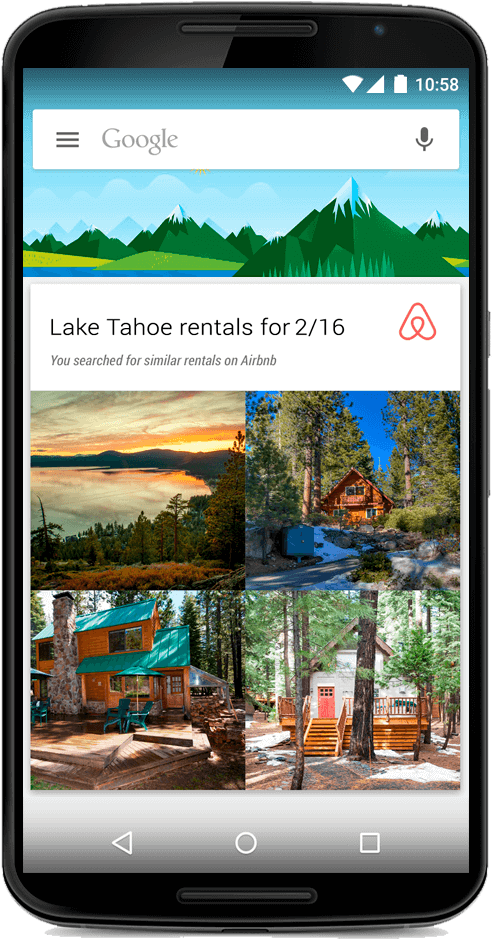
Here is a picture of how the Airbnb data shows in a Google Now card:

airbnbnowcard

You can check out how these cards work on this sample site.

If you have an app that you want to enable and integrate with Google Now cards, you can read the developer docs that has the technical details behind it. Currently only Event Reservation, Flight Reservation, Hotel Reservation and Restaurant Reservation schema is supported.

Google told us they are currently working with select app developers, specifically on the Android platform but the long term goal is to expand this to a wider set of developers and platforms.

Join your peers at Search Engine Land's SMX West conference for three days of tactical sessions, keynotes and clinics on paid search, SEO, mobile search and more. Send your team and save an additional 15-35%. Register today!

(Some images used under license from Shutterstock.com.)

The best news in mobile marketing every Thursday.

Thursday, January 29, 2015

How To Combine Your PPC & SEO Strategies

ppc-seo-together

Many companies are torn between a Search Engine Optimization (SEO) or pay-per-click (PPC) strategy for their business.

SEO

Since early 2012, there have been many questions surrounding the SEO world with Google algorithm updates, such as Penguin, threatening websites and instilling the fear of consequence for utilizing "risky" SEO tactics.

Looking at ranking in the Google organic search results today - everything is centralized around TRUST. You must be ready to show Google your website can be trusted, and that you are staying within their quality guidelines. And you, as a business, have to provide the user with quality products/services that are relevant to their search.

It's also important to recognize that in 2015, SEO services are not cheap. When you choose to hire an SEO company to work on your website, you are hiring knowledge not just a service! To ensure the best SEO strategy for your site, there may be a combination of audits, and optimizations that must be addressed, as well as ensure that the links built are of QUALITY to avoid a penalty by Google.

In short - the ranking process for SEO can be slow in the "new world".

PPC

Therefore, paid search is a great way to get immediate results.

When it comes to PPC campaigns, you have many option to be choose from to generate traffic and leads to your website/landing page, including:

  • Text Ads
  • Image Ads (Remarketing & Display)
  • Video Ads
  • Product Listing Ads
  • And more!
  • This can be an affordable way to see results. Many experts believe it is best to run PPC prior to your SEO efforts.

    PPC + SEO

    But, there are many things that you can learn and use from having both a PPC and SEO campaign running together.

    Brand Awareness & Exposure

    Running a paid campaign can put your brand name and product in front of consumers when they search.

    The exposure you receive from a paid ad can be a trust signal for consumers.

    Research shows that . .

    Improve Loading Speed And Quality Scores

    Quality score is rated on a 1-10 scale and determined by several factors, including click-through rates (CTRs) and page loading times.

    So, if a page loads slowly, then your PPC ads cost more.

    But in the same respect, one of the determining ranking factors for SEO is site speed - if your site is slow to load, your organic rankings will also suffer.

    Optimize Landing Pages

    There are cues that you can take from your PPC landing pages and apply to SEO.

    It's simple to do testing between two versions of an ad in your PPC campaign: similar pages with different headlines, call to actions layouts and images that you may find one works more efficiently from the other. When you find this, you can apply that knowledge to your organic landing pages (eg. Home page, service pages).

    Another great example: you can test title tags through PPC ads. A specialist can run two ads with different titles, but the same copy. By analyzing data such as bounce rates, time on site, and pages per session, you can determine which title/ad kept the user on the site longer.

    Setting Up Site Search In Analytics

    PPC and SEO strategists can analyze what users may be looking for in the site search box. By analyzing the site search section in Google Analytics, this can tell your PPC strategist that these terms can be showcased in a new campaign and drive these keywords to the page that these users are looking for.

    It also opens an opportunity for the SEO strategist to make revisions to the website to assist users in finding what they are looking for.

    (For more on setting up site search analytics, click here)

    Test Geographic Markets & Demographics

    A PPC campaign can help determine if business from a new market would be successful.

    By creating a new campaign targeting a certain location, the click through rates, and cost per acquisitions can be analyzed to determine the success of targeting this new area. If successful, the SEO strategist can then make changes to the website on-page to target a new region and show customers coming to the website that the new area is serviced by the business.

    Image via mommy peace

    Wednesday, January 28, 2015

    What Happens if Apple Drops Google From Its Browser?

    Photo Apple has tried to strip Google services like Maps and YouTube out of its products over the last several years.Credit Fred Dufour/Agence France-Presse — Getty Images

    When Google reports its fourth-quarter earnings on Thursday, one subject that is almost guaranteed to come up is the prospect that Apple could replace Google as the default search engine on Safari, the basic browser on all of its devices. The search contract between the companies is believed to be up for renewal this year.

    Given that Apple has spent much of the past few years trying to strip Google services like Maps and YouTube out of its products, the natural question is whether Apple will extend that to Google's bread-and-butter search engine. Representatives from Google and Apple declined to comment on their search deal.

    One person who is commenting is Marissa Mayer, Yahoo's chief executive. In a conference call with analysts on Tuesday, Ms. Mayer said Yahoo would seek to replace Google as the default search engine on Apple's Safari browser.

    "Safari users are the most engaged and lucrative in the world," she said.

    Ms. Mayer, who built her reputation overseeing Google's Internet search business, said that Yahoo remained committed to search. The company is discussing changes to its 10-year search partnership with Microsoft, which is at the midway mark.

    So let's say that Apple dumps Google in favor of another search engine like Yahoo or Microsoft's Bing. How bad would that be for Google? According to various reports from analysts, the impact on Google's bottom line would be minimal. There's even an argument that it could come out ahead.

    Central to these analyses are two questions that are difficult to answer. The first: How much does Google pay Apple to be the default search engine on iPhones, iPads and Macs? Estimates are all over the place, from 35 percent to 80 percent of the revenue made for searches that go through the Google search bar. The second: If Apple put a new search engine on Safari, how many people would just switch back to Google?

    Normally, that second question would be nothing but a wild guess about the future. But, as it happens, Yahoo struck a deal in November to displace Google as the default search service on Mozilla's Firefox web browser, which accounts for 3 to 5 percent of searches. So there is some fresh data to at least consider.

    Shortly after the change, Yahoo's share of the United States search market hit a five-year high, according to StatCounter.

    But since then, it has started to erode. After the deal, Google's share of paid clicks from Firefox's updated browser –- the one with Yahoo as the default search engine –- fell to 49 percent from 61 percent, according to RKG, a digital marketing agency. However, within two weeks that share had increased to 53 percent as people either switched their default back to Google or went to Google's home page to search.

    "They have a loyal user base that will find them if needed," said Mark Ballard, RKG's director of research. "The default search provider isn't a guarantee that you can own the marketplace."

    Apple is more important than Firefox, of course. The iPhone has fewer users than phones running Google's Android software, but Apple customers are wealthier and spend more, something that is important to Google since it is really just an advertising company.

    Despite that, analysts aren't very worried about the prospect of Safari dropping Google. Carlos Kirjner, a senior analyst at Bernstein Research, estimated that in the worst-case scenario Google's 2015 per-share earnings would be reduced by 6 percent from what they otherwise would have been.

    Ross Sandler, an analyst at Deutsche Bank, believes Google could actually come out ahead. That's because while Google has to pay some unknown amount to Apple for many of the Google searches done through Safari, it would not have to share revenue from whatever "recaptured" searches it got after the deal expired.

    So even if traffic fell, it might end up making more money per search.

    Tuesday, January 27, 2015

    How Google, TripAdvisor and Yelp can help your business

    Jan 27, 2015, 12:00pm EST

    wendy headshot

    Enlarge Photo

    Wendy Taylor, an Internet marketing professional, is president of Strategic Online Marketing.

    Wendy Taylor, Guest columnist

    There's one key thing Google, TripAdvisor and Yelp all have in common that you need to know for your business: They can enhance your search engine optimization.

    Online reviews often are overlooked by many companies for a variety of reasons. Usually the biggest hurdles to getting online reviews are simply:

  • Who in your organization will ask for them?
  • What most people miss is the fact that growing their online reviews will help them with their SEO. Online reviews can help you place ahead of your competition in organic search.

    For example:

  • Google Map searches now feature reviews more prominently, this will offer you greater free exposure in organic search results.
  • According to BrightLocal, 85 percent of consumers read up to 10 reviews before they feel they can trust a business, and 72 percent of consumers say positive reviews make them trust a local business more.
  • Google continuously works to enhance the user experience, showing the best businesses first. Showing those businesses with the most reviews at the top of the search engine results page will continue to improve the user experience.
  • How many of us have had a terrific experience with a business? We all have had good experiences at one time or another and probably wouldn't mind writing a review if only we were asked to do so. Whether it's a tree trimmer, restaurant, hotel or lawn care service, all businesses are subject to review.

    Positive reviews are like bonus points in the eyes of the search engines. The more reviews you get, the more bonus points you acquire, the higher you may climb in organic search — and this is the free, not the paid positioning.

    Wendy Taylor, an Internet marketing professional, is president of Strategic Online Marketing. She can be reached at (407) 341-0582 or via www.strategiconlinemarketing.net.

    Monday, January 26, 2015

    SEO Weekly Roundup: Google Edges Towards New Algorithm, Predicts Disappearance of Internet

    This week, Google has provided what may be its strongest signal yet that it plans to introduce a new mobile usability ranking algorithm, whilst its executive chairman Eric Schmidt predicts that the Internet is on the road to disappearing altogether. Tom Williams dives deeper into these stories, and shares three more pieces of exciting SEO news from the last seven days…

    Do Google's Mobile UX Warnings Mean a New Algorithm is Inevitable?

    Google has sent mass mobile usability warnings to webmasters, adding fuel to speculation that the search giant is preparing a new algorithm to tackle mobile-unfriendly websites.

    The Webmaster Tools notifications, which were first noted last Monday, detail the number of pages found by Google to have "critical mobile usability errors", and warn that "these pages will not be seen as mobile-friendly by Google Search, and will therefore be displayed and ranked appropriately for smartphone users".

    Google has already given plenty of warning that a new algorithm may be in the works. Most notably, it launched 'mobile-friendly' labels next to compliant sites in mobile search, and said it was "experimenting with using the mobile-friendly criteria as a ranking signal."

    The warnings seem only to have been sent to sites that have notable mobile UX (user experience) issues across the board, rather than sites that have minor issues on certain pages.

    Our opinion? We reckon a new algorithm is inevitable, since Google has given plenty of warning by focussing on the subject of mobile UX in talks, statements and actions – not to mention the fact it has admitted experimenting with rankings.

    What's more, this behaviour – mass notifications sent to the worst-offending sites – mirrors Google's behaviour before other big algorithm updates.

    For more evidence, read our news post covering this story.

    The Internet is Going to Disappear, Predicts Google Boss Eric Schmidt

    Google's Eric Schmidt reckons we're facing a future where the Internet will have 'disappeared', thanks to the profileration of always-on gadgets.

    As reported by The Hollywood Reporter, Schmidt was fielding questions at the World Economic Forum in Switzerland, when he was asked for his predictions on the future of the web.

    According to Schmidt, the dominance of connected devices will mean that the Internet will permeate our everyday lives to the point that we no longer notice it existing:

    There will be so many IP addresses… so many devices, sensors, things that you are wearing, things that you are interacting with that you won't even sense it. It will be part of your presence all the time.

    "Imagine you walk into a room, and the room is dynamic. And with your permission and all of that, you are interacting with the things going on in the room."

    Despite his lofty ambitions for… let's call it the Internet of Everything… Schmidt was confident the new era of the web won't mean we'll have to sit back and watch while robots take over our jobs. Instead, he predicted a new wave of jobs will emerge – just as people found new careers after farming became machine-led.

    Schmidt expected the changes would lead to "a highly personalised, highly interactive and very, very interesting world".

    But what's going to happen to Google?

    Right To Be Forgotten Won't Extend Beyond Europe, Google Says

    Google has told European privacy regulators it won't remove links flagged up in Right To Be Forgotten (RTBF) requests outside of Europe, reports Reuters.

    The controversial RTBF legislation, introduced in May last year, allow any individual in Europe to request removal of "inadequate, irrelevant or no longer relevant" links from Google's European index – typically because the linked content is embarrassing or defamatory.

    Google has processed tens of thousands of requests since the ruling was put into force. EU privacy watchdogs, however, have pushed the search giant to extend the link removals to its global results, as users in Europe can still access the unaffected Google.com page.

    Google's chief legal officer, David Drummond, told attendees at a Brussels event that the firm had stood by the ruling:

    We've had a basic approach, we've followed it, on this question we've made removals Europe-wide but not beyond."

    He continued:

    It's our strong view that there needs to be some way of limiting the concept, because it is a European concept."

    Bing Testing Revamped News Card, Google-Like Layout

    Search sleuths have unearthed test versions of Bing's search interface, including an expandable news card, and a layout that mirrors Google's.

    All Google Testing, a blog that shows users how to access test versions of Bing, Yahoo! and Google, published instructions to access the revamped news cards on Tuesday.

    The experimental news box shows three stories, but when an arrow is clicked to expand it, two more are shown.

    All Google Testing put together a video, so you can see the potential new feature in action:

    The Google-aping interface test was uncovered on Thursday, days after Yahoo! was discovered to be running similar tests. Here's the video of the Google-Bing crossover in full swing:

    White House Uses SEO to Ensure Users Are Switched On to Obama Speech

    The White House dabbled in SEO to ensure users switched on to President Obama's State of The Union address on Tuesday.

    As Danny Sullivan at Search Engine Land reported, the White House published a story titled 'What Time is the State of the Union?', presumably in order to appear for relevant high-value search terms.

    The US Government was, it seems, aiming to give users access to the official, White House-approved timings, as well as advertise the interactive features it introduced this year.

    If, however, the White House was aiming to secure better viewing figures for this year's address, then things didn't play out like they planned. According to International Business Times, quoting data from Nielsen Media, viewership was down 1.6 million on 2014.

    Read last week's SEO news roundup: Google Knowledge Graph Now Appearing On 25% of Searches

    Download your free link auditing and removal guide, with practical tips to protect your site from Google penalties.

    Sunday, January 25, 2015

    Is Google Fiber the Future of the Internet?

    Google, the search engine giants, have ventured into providing internet access to consumer through their much acclaimed Google Fiber service. With gigabit internet speeds, the new connection speeds go beyond the range that other internet service providers are able to provide thus giving them a run for their money.

    Google Fiber has gained a lot of popularity in recent times and as it continues to grow and expand their reach, the question that still linger in our minds remains. Could Google Fiber possibly be the future of the internet?

    In order to gain a better understanding of Google Fiber, it is important to know about the company behind it. Google started out as a search engine and still remains to be one of the most popular search engine to this day. The tech giant has ventured into other areas such as mobile with their android devices, video through YouTube and even social networking via Google+. This is just a glimpse of the many services that are provided by Google.

    Google was founded by engineers and technical type people who prefered efficiency of systems as well as their reliability. It would seem that this same mentality was a key factor in the design and implementation of the Google Fiber network. The network is capable of amazing download and upload speeds which places content virtually at the tips of your fingers. Let us break this down into numbers.

    The average internet service provider gives the consumer between 20 and 100 Mbps connection speeds. By contrast, Google fiber has 1000 Mbps connection speeds. This is 10 times what any other ISP can offer at the moment hence placing Google Fiber way ahead of the curve in terms of speed. Another interesting fact about the speeds that are offered by Google Fiber is that they are bidirectional.

    Typical internet service providers usually provide slower upload speeds as compared to download speeds. In fact, the speeds that are usually advertised are the download speeds. Google Fiber is different with the 1000 Mbps connection going both ways. At the same speed that you download files on the Google Fiber network, so can you upload your files to the cloud or some other server on the internet.

    With increasing demand for fast and reliable connections to the internet, it is necessary to have a solution that can provide both speed and efficiency. As with all innovations, there are those who will be ahead of the competition and Google seems to have taken the lead with their Fiber solution.

    Though not as widespread as other internet service providers, Google Fiber has a lot of promise. We hope to see a lot more innovation from other internet service providers in order to provider faster speeds to the internet on a reliable connection.

    Google Fiber has shown up what is possible when it comes to internet connectivity. The amazing speeds provide a reliable access to all kinds of content on the internet regardless of their size. As applications become more resource intensive, we expect to have faster speeds such as the ones introduced by Google Fiber. This is the future of internet connections.

    Friday, January 23, 2015

    Automatic AdWords Currency Conversion Now Enabled In Google Analytics

    ppc-click-money-ss-1920 Today, Google announced that Google Analtyics and AdWords will now be able to speak the same currency language. The change affects advertisers that happen to use a different currency for cost data in AdWords than Analytics.

    With currency conversion, advertisers will be able to easily compare cost data from AdWords in Analytics. Google Analytics will automatically convert cost data from AdWords — cost, CPC and ROAS — in the currency that is set in the Analytics account.

    Google uses the exchange rate at the midpoint of the date range selected in Analytics.

    "For example, if you are viewing a time period from January 5th to 19th, we will use the rate from January 12th to convert your AdWords cost data to the currency of your GA account."


    Join your peers at Search Engine Land's SMX West conference for three days of tactical sessions, keynotes and clinics on paid search, SEO, mobile search and more. Early bird rates expire January 30th – register now and save $200. Send your team and save an additional 15-35%. Register today!

    About The Author As Third Door Media's paid media reporter, Ginny Marvin writes about paid online marketing topics including paid search, paid social, display and retargeting for Search Engine Land and Marketing Land. With more than 15 years of marketing experience, Ginny has held both in-house and agency management positions. She provides search marketing and demand generation advice for ecommerce companies and can be found on Twitter as @ginnymarvin. (Some images used under license from Shutterstock.com.)

    No fluff - just the best news in paid search marketing every week.