
Wednesday, January 7, 2015

Google Link Removal Requests Climb To 345 Million In 2014

Ken Wolter / Shutterstock.com

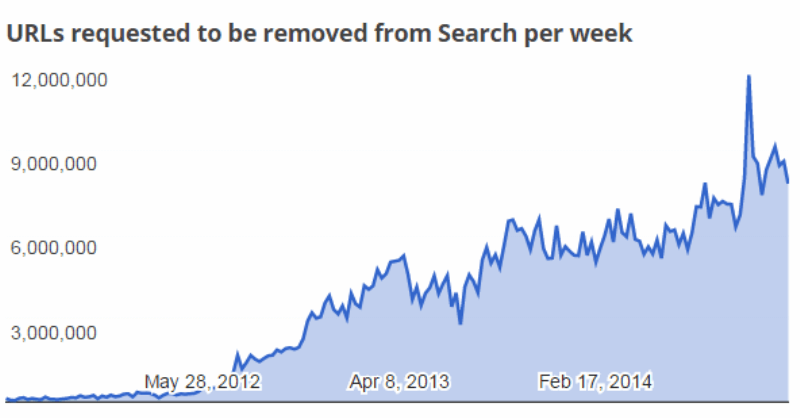
After analyzing Google's weekly link removal reports for 2014, Torrent Freak says the search engine received more than 345,000,000 million requests last year – a 75 percent increase compared to the number of link removal requests in 2013.

With more than five-million targeted URLS each, Torrent Freak said that the majority of takedown requests were connected to three specific domains: 4shared.com, rapidgator.net and uploaded.net.

At TF we processed all the weekly reports and found that the number of URLs submitted by copyright holders last year surpassed the 345 million mark – 345,169,134 to be exact.

"The majority of these requests are honored with the associated links being removed from Google's search results," said Torrent Freak.

Some requests receive a "no action" status if Google determines there is no copyright infringement, or the link has already been removed.

Torrent Freak Google link takedown request january 2015

Join us for MarTech: The Marketing Tech Conference to hear from digital marketing and technology leaders responsible for building the marketing technology capability in their organizations. We'll dig deep into the use of marketing technology to transform customer experience through marketing automation, web experience management, customer data platforms and more. Plus we'll explore the hottest upcoming opportunities, as marketing cloud platforms and over a 1,000 martech start-ups vie to shape that landscape and define how modern marketing gets done. Lowest rates expire January 17 – register today to save $400!

About The Author Amy Gesenhues is Third Door Media's General Assignment Reporter, covering the latest news and updates for Search Engine Land and Marketing Land. From 2009 to 2012, she was an award-winning syndicated columnist for a number of daily newspapers from New York to Texas. With more than ten years of marketing management experience, she has contributed to a variety of traditional and online publications, including MarketingProfs.com, SoftwareCEO.com, and Sales and Marketing Management Magazine. Read more of Amy's articles. (Some images used under license from Shutterstock.com.)

Everything you need to know about SEO, delivered every Thursday.

Tuesday, January 6, 2015

What Google's International Pullouts Mean For The Search World

Google has been operating internationally for as long as it's been around, but a recent chain of pullouts—wherein Google has ceased all or some of its operations—in a number of foreign countries has led to confusion and speculation about the search engine giant's motives. While the pullouts have not affected any services here in the States, it is important to understand Google's motivations in each of the pullouts, and the escalating international tensions that could influence Google's decisions for future development.

The Recent Pullouts

Three countries have been the most recent subjects of Google's pullouts, though the tensions and philosophies that led to each incident have been going on for years.

Spain

Google officially announced that it was bringing its News service to a close in Spain, effective by the end of 2014, and to many critics of a recent Spanish law, it was no surprise. Several months ago, Spain revised its copyright laws by adding a new amendment, which was claimed to be a move against piracy, to take effect beginning in 2015. However, the nickname for the legislation—"the Google tax"—is arguably more accurate in describing its effects.

Under the new amendment, writers and journalists would have the rights to be monetarily compensated for a portion of their work being sampled in any kind of online news aggregation. That means that Google News, which aggregates hundreds of thousands of articles, would be forced to pay writers for snippets of their contributions. Making things even more strenuous, these rights are inalienable—which means they can't be signed away.

As a result of this legislation being passed, Google made the decision to cease News-based operations in Spain completely. Other features, such as traditional search and Google Maps, will still be made available. However, the pullout may not go as smoothly as Google would like. Spanish users are accustomed to accessing "news.google.es" for their news—and that URL is shut down—but there's nothing stopping Spanish users from accessing Google News sites of other countries. Because those Spanish users still have access to article snippets, Spain may attempt to hold Google liable for compensating the authors of those snippets.

Google's motivation here is clearly to avoid the monetary penalties. Spain made a move, arguably against Google, and Google simply responded by withdrawing. Other European countries may soon follow Spain's legislative lead (especially considering the recent "right to be forgotten" controversy, which I cover later in this article), complicating Google's potential for international operations.

China

Even more recently, Google removed its presence in China altogether—any traffic headed to the old Google China domain, Google.cn, now automatically redirects to Google.com.hk. The motivation behind this move is a little more complicated than just a response to new legislation.

For years, the Chinese government has requested that Google censor certain pieces of information, and alter search results for the Chinese population—an example includes the censorship of the 1989 Tiananmen Square protests—and Google has more or less fulfilled those requests. Their recent pullout suggests that Google is no longer willing to abide by China's regulations, as searches performed on Google.com.hk, are wholly uncensored. Unfortunately for Chinese citizens, the Chinese government can still control whether their citizens have access to Google.com.hk, but Google has made its stance known.

Google's official statements, from renegotiations with China earlier this year, suggest that a series of cyber-attacks and infringements on private citizens are responsible for Google's decision to pull out. All Google services, including Search, News, and Images, are no longer available (though are still provided on Hong Kong servers).

Google's decision here isn't necessarily a logical business choice, as it was with its decision in Spain. Instead, Google is interested in maintaining the availability of information and private security of as many citizens as possible, Chinese or otherwise. This move suggests Google is willing to stick to its values, even in the face of international pressure to do otherwise.

Russia

Google has also recently announced that it will be closing its engineering headquarters in Russia, which began on January 1. This decision comes as a direct result of a new bill that was passed into law by Russian Parliament. Under this law, all foreign Internet-based companies (including Google, of course) would be required to store any and all data on Russian citizens within Russian borders. Though the legislation is not set to be enforced until 2016, Google is pulling out immediately. Traditional Google services will still be made available to the Russian population.

Russian Parliament's justification of the law is that it was intended to protect Russian users' private information from international espionage attempts. However, most critics realize the more likely motivation is an attempt to limit the availability of information.

Google's decision in Russia is in response to a new law that would limit their operational capacity, much like in Spain, though its primary motivation is more similar to the decision in China—Google wants to maintain the open availability of as much significant information as possible.

Tensions in Europe

The legislation in Spain, in particular, didn't come as a major surprise. Europe has been putting pressure on the search engine giant for the last few years, but especially in recent months, as concerns over private citizens' data and rights have spread throughout the continent.

The "Right to Be Forgotten"

Tensions started to dramatically escalate in May of 2014, when the European Union started to roll out a "right to be forgotten" privacy ruling that mandated online users have the ability to request certain links to their personal history or information be removed from search engine indexes. Essentially, private citizens would have some degree of control over what information was published about them on the web.

As a result, Google was forced to remove over 169,000 links (with that number still growing). Many believe the new ordinance is a step forward for citizens' rights to privacy, it also puts Google in an uncomfortable position, since its primary objective is making information available to the public.

Google as a Monopoly

The European Parliament has also been investigating Google for its violation of antitrust laws, attempting to determine whether the company constitutes a monopoly over Internet search services. Google is the dominant competitor even on an international scale, and as a result, the EU is threatening to break the company up into smaller derivatives.

Fines from Multiple Countries

In addition to the pressure from the collective European Union, Google has also faced pressure to update its privacy policy in a number of European countries. The Netherlands most recently issued a warning that Google would be issued an $18.7 million fine should it fail to update its policy by February of 2015. This comes on top of fines already issued by Spain and France.

What It Means for Google

The international pressure on Google is ratcheting up, both in terms of new legislation designed to weaken the company's power, and new efforts to either protect or restrict each country's respective population. Google's priority has always been to make the most information available to the greatest number of people, and its recent decisions in China, Russia, and Spain showcase its adherence to those principles.

Going forward, it's unlikely that the international pressures on Google will recede. Instead, the European Union will likely continue its efforts to weaken the search engine giant and provide more privacy and protection for its citizens. Undoubtedly, Google will attempt to hold its current position, but its approach to information provision and user privacy may major change.

Monday, January 5, 2015

GOOGLE 'C' : Juiced SEO Launches Special Search Engine Optimization Service for Local Businesses

Powerful, targeted new program produces most impressive results yet, incorporates proprietary techniques that have already proven to be among the most effective anywhere, Juiced SEO reportsVancouver, BC -- (ReleaseWire) -- 01/05/2015 -- Juiced SEO, Vancouver's top search engine optimization agency, launched a new service aimed at helping local businesses reach the top of Google's search results. Utilizing a mix of techniques customized to best suit each client, the just-launched service focuses on producing business-building results and generating impressive returns on investment. Juiced SEO's best-in-class search engine optimization services have already proved invaluable for a long list of clients in Vancouver and elsewhere, and company representatives expect that the new program will be even more effective.

"With our relentless focus on producing results for our clients," Juiced SEO representative Paul Tufts said, "we never settle for anything less than being at the forefront of the industry. This commitment to staying at the top in terms of effectiveness has allowed us to put together a special new SEO offering that is already delivering more leads and generating more revenue for a number of our customers."

With the vast majority of Internet users rarely looking beyond the first page of results they receive from search engines like Google, placing high in those lists is a key requirement for exploiting the potential of digital marketing. Simply commissioning a high quality website, while important, is rarely sufficient for realizing this goal, because competing companies will almost inevitably take steps to proactively boost their own placements, pushing more passive businesses away from the top and taking for themselves the lion's share of the online traffic that search engines generate.

With an intense commitment to generating real, verifiable results for the company's clients, Juiced SEO in Vancouver has become the region's number one specialist at search engine optimization. The company's search experts belong to a range of the digital marketing world's most exclusive and influential trade groups, leveraging their access and connections in the development of SEO strategies that rise clearly above those available elsewhere in the area.

This laser-like focus on figuring out how to deliver impressive results to clients has resulted in the creation of the company's just-announced new local business SEO package. Incorporating a number of important insights developed over the course of the last year in consultation with many of the world's top SEO experts, the new strategy ably accounts for a number of significant recent developments among the algorithms Google uses to automatically rank sites for its search results.

As a result, the new Juiced SEO service is more effective than any others available in the Vancouver area, putting the company even more squarely into the leading position in the region. As with all of Juiced SEO's services, the new program includes advanced analytics reports that give clients a clear-cut picture of the results it produces, as well as close, personal communication with the experts responsible for carrying it out. Those interested in the new offering or any of Juiced SEO's other services can learn more at the company's website, as well as arrange for free consultations there.

About the Juiced SEO AgencyProducing impressive results and compelling returns on investment, Juiced SEO uses a wide range of powerful techniques to boost the search engine rankings of clients' sites, generating more leads and revenue.For more information on this press release visit: http://www.releasewire.com/press-releases/release-572370.htm

Media Relations Contact

Paul TuftsTelephone: 604-259-1456Email: Click to Email Paul TuftsWeb: http://juicedseo.com

© Acquiremedia 2015

Sunday, January 4, 2015

SEO 101: 6 Strategies For Building Private Blog Networks That Work

FacebookTwitterGoogleLinkedin

There is a lot of talk about private blog networks and whether they are an SEO goldmine or a high risk that should be avoided. After all, SEO is all about "quality content" these days right? Wrong.

I am here to tell you that private blog networks still produce amazing results when done correctly (emphasis on correctly). Do they work? If they didn't would Google continue to sniff them out and take action against them? A private blog network is a network of websites that are created to look like real sites, but they only exist to pass link juice around. This is a gray/back hat method used by more people than you think.

You see, the majority of people somehow don't understand what the true definition of "private" is. According to the dictionary, "private" is an adjective meaning, "belonging to or for the use of one particular person or group of people only." If you visit any of the SEO forums you will see everyone and their brother selling private blog network (PBN) links. Private? These are far from being private because they are selling to anyone willing to pay, therefore exposing their "network" and putting everyone at risk.

If you buy self-proclaimed private blog network links and got wacked, you can't say they don't work. What you can say though, is that PUBLIC blog networks don't work and they are high risk. Think about it for a moment – what is to prevent or stop a Google employee from ordering and either using the report these sellers provide or tools to discover the links and quickly crush any site linked. They could do this is a single afternoon if they were really bored and wanted to ruin some people's day.

You are wasting your time if you purchase PBN links that are really public blog network links. If you are serious about rankings, then you need to build your own networks and keep it truly private. Let's go over some simple steps to help you build a network of sites that you can use for your own personal SEO benefit.

Identify Quality Domains

There is absolutely zero benefit of building a network of crappy sites. Google loves signals of trust from websites that they deem as high quality. While you always want to go after niche related domains, the truth is finding a large amount of high quality domains in a single niche is not realistic.

Ignore page rank. Too many people get suckered into chasing PR and they end up with domains that have zero backlinks and a high PR due to redirects. Remove page rank from your vocabulary when looking for domains. Look for domain names that are very broad, because you can always make them more niche-custom by alerting the title tags, meta descriptions and themes/logos.

You want to turn your focus to the link profile of any domain you are considering adding to your network. Spammy links and spammy anchor text should always be avoided. Look for domains that have high quality links from authority websites. If you see domains with 10k inbound links and Chinese anchors run far away and never look back. Avoid using these "bulk domain checking" tools – they aren't always accurate and if you are serious about building a solid network you will need to check them all manually.

Here are some of my favorite tools to use to dig deep into the link profiles and history of domains I come across:

Open Site Explorer

moz seo research

moz seo research

Many SEOs talk about Moz's Domain Authority (DA) like it is the second coming of Google's page rank. It can be a decent metric to analyze, but it can be inflated with pure spam. It is important that you don't just look at the DA and skip over actually combing through the link profile. Use common sense when checking a domain through OSE. If a domain has a DA of 15 but has a few high authority inbound links it can still be a very strong domain. With that being said, a domain with DA 50 that contains spammy links is completely worthless and would be toxic if you added it to your network.

Ahrefs

ahrefs seo tool

ahrefs seo tool

Ahrefs will typically give you the biggest link profile to dig through. Look for high quality links and kick that domain to the curb at the first sign of low quality links. You have to be very picky, because once you start to let one or two spammy links into your network of sites you essentially let your guard down and put everything at risk. Use Ahrefs to analyze the anchor text profile and ratio as well. Look for a lot of brand anchors and avoid anything with anchor heavy keywords that reek of spam.

Majestic

majestic seo tool

majestic seo tool

Last year everyone was on the Domain Authority bandwagon. Well, for 2015 get read to jump on the Trust Factor (TF) train. Majestic's TF metric is one of the hardest to unnaturally inflate, in my opinion. Will that always be the case? There is no way to tell, but for the time being it is very solid. As a rule of thumb I won't even consider a domain that isn't TF15 or higher. Again, there are so many different factors to consider – and Majestic is also another great tool to look into the link profile of a domain.

Way Back Machine

way back machine

way back machine

The last thing you want to do is add a domain to your network that was previously used in a network. Use Way Back Machine to check the website history as far back as it will let you. See what kind of site it was all the way from the beginning up until just before it was dropped. If you see any low quality content or spammy footer and sidebar links toss the domain into the reject pile. This can also give you a good idea about how to "rebuild" the site for your network.

What Are Clean/High Metric Domains Worth?

Honestly, they are worth whatever you are willing to pay for them. There is no right or wrong answer here. It all comes down to the niche, the link profile, and good old fashion supply and demand. I have seen great domains ranging from the registration fee to a few hundred dollars. I would highly suggest you spend some time learning what to look for before you go on a domain shopping spree.

Locate Golden Domains

Everything we have talked about up to this point is useless if you don't know where to find good domains. I have three "go-to" sources when it comes to buying domains for a network. One requires a lot of time and effort, but the price is great. Another will typically have some really good offerings but the prices can skyrocket into bidding wars, resulting in overpaying for a domain. The last one is the ultimate lazy-person dream.

ExpiredDomains.net

expired domains

expired domains

I check ExpiredDomains.net multiple times a day and I like it because they offer a lot of filtering options. Remember, in order to really find great domains, you have to do a lot of manual work, so anything you can use to make that easier is welcomed. Their filter system will allow you to sort by PR, DA, TF, and domain character length, just to mention a few. There is also an option to eliminate fake PR, but don't rely on this alone as you MUST manually research any domain you are considering. Yes, it is a lot of work, but it is well worth it.

This is a great tool to get yourself familiar with if you are just getting started acquiring domains. These domains are available to register, costing you just the registration fee.

GoDaddy Auctions

godaddy auctions

godaddy auctions

GoDaddy auctions are my favorite source to find very strong niche related domains. Yes, you are going to pay a premium, but they can be a great source for some very healthy metrics. However, sometimes the bidding can get out of hand, and I have personally seen domains that were worth no more than $100 sell for thousands.

I will check the auctions on a regular basis and watch domains that I am interested in. I determine the max price I will pay for a particular domain and once it goes beyond that price, I take it off my radar. You have to be very disciplined when buying domains at auction. Don't let the bidding game or your emotions come into play. That is how unnecessary spending occurs.

SEMimpact

semimpact

semimpact

Searching through link profiles and analyzing metrics takes time and I value my time, so this is my third source for domains. SEMimpact is an affordable source of domains that have already been analyzed and vetted. You can secure domains that are niche specific and meet your required metrics at an affordable price.

There is nothing like the rush of uncovering an expired domain with a sweet link profile, but it takes a lot of digging to find the gold. This is great option for people looking to build up a large network fairly quickly and don't have the time or patience for the hunt.

Smart Registration Required

It would be extremely convenient to have all of your network domains in one registrar account, but that is a huge footprint you need to avoid. You might think it will be a pain to manage several different registrar accounts, but as long as you are organized it really isn't that much of an inconvenience. You want to build your network knowing that there is a very good chance Google will be looking at your websites. Non-existing footprint = less likely that your network will become discovered.

Create an excel spreadsheet to make your registrar management simple. I would suggest spreading your domains across as many registrars as possible. As your network grows you can continue to add to each, but always be on the lookout for new registrar options.

Multiple Hosts Are Key

Do not host all of your sites on the same server, the same host, and avoid anything that is labeled as "SEO hosting" if you want to avoid waving a major red flag that screams, "Hey, Google…over here! Please de-index all of my sites!" It amazes me how many people will spend time and money to build a private networks of sites only to try to save a few dollars on hosting. Then they get mad when their not so private network is discovered.

Use separate hosting accounts for each site, spread across as many hosting companies as you can find. This gives you major IP and server location diversity. Again, staying organized is key. Keep a spreadsheet that contains all of your login details to make your life easier. If you aren't willing to spend a few dollars per site to host your network then this isn't for you.

Be Smart When Building Your Sites

WordPress is the easiest CMS out there, but you can't have all of your sites built using WordPress and you MUST use a different theme for every WP site in your network. Again, this helps to avoid leaving a footprint. WordPress can account for a large percentage of your sites, but also add in some HTML, Drupal, and Joomla sites for some diversity.

Make sure each website has an about page, functional contact page, custom logo, and detailed navigation. A terms of service and a privacy policy page is also a good idea. Limit each site to 2-3 links per homepage. If you have a sidebar or footer loaded with links (especially keyword heavy anchors) you will get nailed eventually. You want to also include some outbound links to authority sites to make it all look very natural (and real).

Feed Your Sites Regular Content

One of the biggest mistakes I see people make is completely ignoring their sites once they build them and add their links. I'm not saying that you need to add new content daily, but you should be adding new content at least a couple of times every month. Some niches will require very frequent updates to keep them looking real.

Include images, video, and outbound links to niche related authority sites in your content. Never drop unrelated links in the content you add and never use cheap spun or outsourced low quality content. I've seen sites that got very lazy and started to update with spun content that was barely readable. That is a major red flag. Get yourself a quality writer if you value your network and want it to be around for a long time.

Build Links to Your Network (But Not From Your Network)

Never interlink your sites. Now that we have that out of the way, let's talk about link building. A real site is going to have inbound links on a semi-frequent basis. Not all sites are going to have them coming in rapidly, but a link here and there will help paint the picture of the site being real.

Build a few decent links to your network sites every month and make sure to share your new content over social media, but never from the same accounts. Hey, nobody ever said this would be easy, hence the reason why so many fail. Laziness will kill a private network faster than anything else!

There are no shortcuts when it comes to this. You are either in or out. When you are smart about it and do it right the results can be amazing. Also, remember to keep your sites truly private. Never rent out links or share them with anyone.

What are your thoughts about private blog networks? Let's hear them in the comments below.

Image Credits

Featured image: igor.stevanovic via ShutterstockAll screenshots taken December 2014

Alan Schill

Alan Schill

Alan Schill

Alan Schill

Alan Schill Alan Schill is passionate about all things digital marketing. As the founder of Denver, CO based LawFirmAuthority.com, he oversees all marketing and digital lead generation strategies for the company and the law firms they serve. Alan Schill

Alan Schill

Alan Schill

Alan Schill

Alan Schill

Alan Schill

Alan Schill

Alan Schill

Latest posts by Alan Schill (see all)
  • SEO 101: 6 Strategies For Building Private Blog Networks That Work - January 4, 2015
  • SEO 101: 18 Search Rankings & Engagement Factors You Can't Ignore - November 14, 2014
  • How To Increase Conversions With 10 Landing Page Tweaks - October 10, 2014
  • Saturday, January 3, 2015

    4 things to expect from Google in 2015

    Google wants very much to be known as more than just a search company, and over the next year many of its biggest moves will be in other areas.

    168802492.jpgMany of Google's biggest moves in 2015 will come outside of search. Getty Images

    Google is a powerhouse, but it's a powerhouse in transition.

    In 2014, Google's search engine -- the largest in the world -- continued to dominate the market. In the US, the company has 67 percent of the search market on desktop computers. Globally, it's a $50 billion business in revenue annually.

    But as Google looks to where future revenue streams will come from, CEO Larry Page hasn't been shy about saying the company has needed to expand its vision. When Google was founded in 1998, it gave itself the mandate of "organizing the world's information." Now that means a lot more than just search.

    "I think the mission statement is probably a little bit too narrow and we're thinking about how to do that a little more broadly," Page said in December.

    So, not surprisingly, much of what's expected from Google over the coming year has little to do with its juggernaut search business and more to do with its ever-growing en terprises outside of search -- from YouTube to its secretive lab Google X to its dominant Android platform. Here are four things to consider when looking at Google in 2015.

    1) The consumer launch of Google GlassRemember Google Glass? The Internet-connected smart eyewear, which captured the attention of geeks and the tech media, launched in a limited program in early 2013 but had gone relatively dark in 2014. Google is expected to release the consumer version of Glass sometime this year.

    The device, which Google co-founder Sergey Brin previously intended for a wide release last year, has been met with both fascination and scorn since it was unveiled in 2012. It has particularly touched a nerve with those concerned about piracy and privacy. Glass, which has a built-in camera and recording device, has been banned from movie theaters by the Motion Picture Association of America and has also been banned by some bars.

    The launch of the consumer version of Google Glass was previously expected to come this year. CNET

    But for all the controversy Glass has stirred up, the device is still technically on a very public test run. Google strategically planned a slow rollout, calling the first people to own the device "explorers."

    It's unclear what the product will offer once it moves beyond its prototype phase. Some analysts expect a price drop from its original, "explorer" price of $1,500. Paul Saffo, a Stanford professor and Silicon Valley futurist who's observed the industry for decades, believes the price was deliberately steep to temper expectations. "If it had a consumer price, people would expect consumer functionality," he said.

    Others say the product will be better as a result of the hardship early on. "What we see in version 2, 3 or 4 is going to be significantly better because of the failure of version one," said Sameet Sinha, an analyst at B. Riley and Co.

    2) A push to get TV ad budgets to YouTubeGoogle has been making big inv estments in YouTube, its premier online video platform. The company has fought to keep its top creative talent on the service, especially as rivals like Facebook and startups like Victorious aim to crowd YouTube's turf.

    There's good reason for that investment. YouTube gets more than a billion unique visitors every month and streams about three months' worth of video to viewers every minute. eMarketer predicted that video ad revenues from YouTube in the US would hit $1.13 billion by the end of 2014.

    Google wants to cash in on YouTube even more. In the advertising world, television has traditionally been where brands and agencies spend the most money. But analysts say that's poised to change. Ad spending on the Web is set to overtake ad spending on television in 2016, according to a study published in November by Forrester (though that includes all types of Web-based ads -- not just online video).

    Several big tech companies have upped their investments in online vid eo ads over the past couple of years. In November, Yahoo bought the ad-tech company Brightroll for $640 million -- the second largest acquisition CEO Marissa Mayer has made since taking Yahoo's helm in 2012. AOL bought Adap.tv, another video ad-tech company, in 2013.

    Sinha said he thinks Google will more aggressively go after making deals with big brands and advertising agencies to bring their ad budgets to YouTube. The company has already started making those pacts. In February, Google struck a deal with Magna Global, one of the world's largest advertising buyers. Magna Global is a unit of IPG Mediabrand and invests $37 billion a year on behalf of its clients. The deal reportedly committed about $100 million of marketing money to Google websites, including YouTube.

    Another hint about Google's commitment to bringing big ad budgets to YouTube? The company in February put Susan Wojcicki, one of Google's earliest and most senior executives, in charge of YouTube. Wojcicki previously spent years running Google's overall advertising business.

    "It can't get much more senior than that," said Sinha.

    3) Android everywhereArguably no division inside Google was busier in 2014 than the one in charge of Android, the company's mobile operating system. The software already powers more than 80 percent of the world's smartphones, and Google took major steps in 2014 toward expansion.

    In September, the company launched Android One, an initiative aimed at bringing affordable, high-quality Android phones to emerging markets. The project, which guides handset makers in what components they should include in their hardware, originally launched in India. In December, Google expanded the program to Bangladesh, Nepal and Sri Lanka. The company originally planned to launch in the Philippines and Indonesia by the end of 2014, but those launches -- along with launches in other countries -- will likely take place over the coming year.

    In November, the company began to roll out Android Lollipop, which Google product czar Sundar Pichai called the company's "largest, most ambitious" release yet of the OS. The update is a major overhaul of the software's design and user interface.

    Google Android chief Sundar Pichai launched the company's Android One initiative in India in September. James Martin/CNET

    B. Riley and Co's Sinha thinks those efforts mean Android is poised to make a jump in quality. "What we see [in 2015] is Android coming out with significantly better phones than what we see now," he said.

    Google has also made big bets in wearable devices. Along with Glass, the company has focused on Android Wear, a modified version of Android tailor-made for wearables like smartwatches.

    The payoff could be big. By 2018, shipments of wearables will surpass 100 million units, an almost sixfold increase from 2013, according to research firm IDC. Competition in the market will also heat up soon, as Apple gets set to release its own wearable, the Apple Watch, in early 2015.

    The chief knock on wearables in the early goings has been that many of them are still too expensive and that there are not many uses for them yet. But Google says it's committed to helping Android Wear mature at a fast rate. "We want to be able to iterat e very, very quickly," Hiroshi Lockheimer, Android's top engineer, told CNET in September.

    4) Ongoing scrutiny in EuropeThough Google has focused its efforts on several new businesses, search is still the company's bread and butter. And the company's dominance there will likely give Google headaches as antitrust probes continue into 2015.

    Google has been embroiled for the past four years in an antitrust investigation in Europe. The case delves into allegations that the company prioritizes the results of its own properties -- like YouTube or the Google+ social network -- over the results of competitors. Google has also been the main target of a European court's ruling known as the "right to be forgotten," which lets people request their names be excluded from search results if the content is irrelevant or outdated.

    The European Parliament has also filed a public motion in favor of splitting up Google's search business from the rest of the company (though Google wa sn't actually mentioned by name). The motion itself is toothless, but it puts political pressure on the European Commission -- which sets the region's political agenda -- as it probes Google. It also underscores an unfriendly political tone toward the company.

    "All of it really reflects broad suspicion of Google in Europe," said Jan Dawson, an analyst at Jackdaw research. Dawson said he expects the European Commission to implement rules around how Google can "cross-promote" its own products on search.

    The Commission's antitrust investigation of Google has been drawn out since it began in 2010. After three previous attempts, Google and European regulators haven't been about to agree on a settlement. Europe's new competition chief, Margrethe Vestager, who took the post in November, has indicated she would listen to all complainants before deciding how the investigation would proceed.

    Friday, January 2, 2015

    Breaking The Glass Ceiling Of Search Through Acquisition

    glass-ceiling-ss-1920

    When you're working on an SEO campaign within a particularly competitive niche, it can sometimes feel that for every step forward you take, your competitors are taking an extra two. This is particularly relevant when you come into a niche where there have been a select number of really powerful domains that have dominated the first page of Google for the majority of keywords you're targeting for several years.

    This isn't unusual at all. It's particularly relevant within the blogging world where you will often see the same few blogs appearing for a number of search terms related to what they cover. Let's take the SEO niche as an example. Just run a search for any of the following keywords:

  • link building
  • on page optimisation
  • local SEO
  • After glancing over the first page of Google, you'll start to see a few familiar faces appearing regularly. Moz, Search Engine Land, Search Engine Journal and Search Engine Watch will frequently be popping up on the front page for most terms related to SEO.
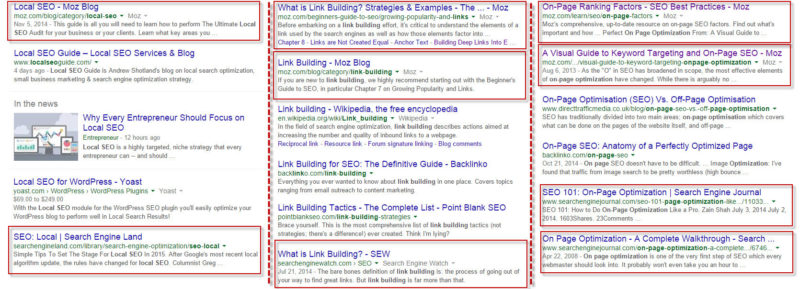
    The Usual Suspects...

    For someone with a relatively new site, or even an established site, it can be quite a daunting prospect to go head on and challenge the big boys for really competitive search terms.

    If you're serious about competing in highly competitive niches, you'll need to be prepared to spend the kind of money that the competition are. That's not to say that you can't compete with them on a smaller budget, but if you're looking to get to where you want to be in any time soon, investment is going to be needed.

    Now, before I get a ton of responses that say, "Just use some clever black hat SEO to get you there," I want to make the point now that I'm talking about competing with as little risk as possible.

    I don't doubt for a second that someone could go and rank for an incredibly competitive phrase within a few weeks or even days using certain link building methods. That said, I've never liked the idea of building out a brand that has an unnecessarily large risk of being ruined when there are alternative approaches.

    Acquisition

    The approach that I'm going to explain here involves acquiring other websites and migrating them directly within your own website.

    You're probably thinking that this is going to also involve large sums of cash to be able to even think of doing something like this, but the reality is that you don't need to be acquiring huge websites at all. In fact, most of the campaigns that I have worked on where I've used acquisition as a tactic have involved acquiring a number of smaller sites that have cost less combined than one large website.

    Before I get into the details of how to use this technique, let me just outline some of the main benefits to website acquisition:

  • You inherit their link profile and a large portion of their domain's authority.
  • All of the acquired website's content will become yours and will dramatically increase the size of your website.
  • In some cases, you will be able to directly migrate their search engine rankings over to your website.
  • There is the potential to absorb their current user base of followers and any social media sites they have.
  • If the acquired website has a mailing list that have opted-in to third party sharing, you may be able to utilise this as well.

  • website acquisition benefits diagram

    Executing An Acquisition Successfully

    The first step in this process is to identify a website that could be a potential acquisition target. There are a number of different ways to go about this, each with their own advantages and disadvantages. To keep this as simple as possible, we'll look at the two main ways:

  • Bidding through website auction sites like Flippa.
  • Identifying target websites outside of auction and approaching them with an offer.
  • The advantage of going through route 1 is that you know that the website owner is looking to sell. The only downside to auction sites is that you'll often pay a premium because there is more competition.

    With route 2, the advantage here is that you will have little to no competition when it comes to bidding, meaning that there's a greater potential to grab a bargain. The downside is that you can often spend a lot of time analysing websites that fit your criteria, but a lot of them just aren't looking to sell.

    I'm not going to go into too much detail around the buying process as that could be a whole post in itself, instead I'll share with you the key attributes of a website that I look for when considering an acquisition:

  • The content is relevant to my core website. More specifically, I'd look for websites that have good search engine rankings for some of the keywords that I'm targeting.
  • There is a good spread of linking root domains to the website and the link profile looks natural.
  • Traffic from the search engines contributes to a large percentage of overall traffic. You can use tools like SimilarWeb to analyse this.
  • In an ideal situation, the website would be built on the same CMS as my core website. WordPress makes it particularly easy to import the content from another website without having to get your hands dirty in code.
  • There can be a lot more to it than the points above, especially if we were talking more about an e-commerce purchase, but it's important to remember that the core goal of the technique I'm describing is to boost search traffic.

    On To The Technical Part…

    Let's imagine that you've just purchased a new site that you've identified. This site has relevant content, it's built on the same CMS (WordPress) and there are a few good links pointing to the site.

    At this stage, you need to start considering how to integrate your newly acquired site into your existing one, whilst absorbing the traffic and SEO benefits in the process.

    To explain this process in a little more detail, I'm going to walk you through the steps I took when I merged FindMyBlogWay.com into MatthewBarby.com earlier this year.
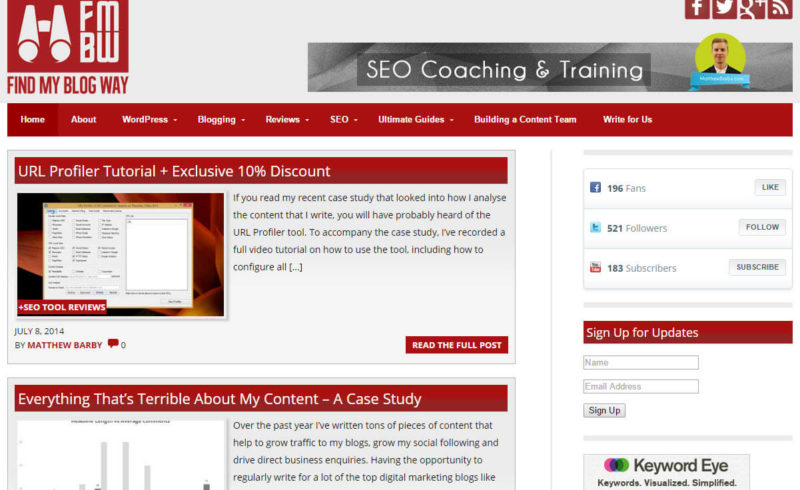
    findmyblogway.com

    The Rationale Behind The Decision

    Before I get into the details of this, I just want to briefly explain the rationale behind my decision to merge FindMyBlogWay.com into my main website.

    Essentially, I purchased FindMyBlogWay.com around a 1.5 years ago for the grand sum of $50. There were a few good links pointing to the website and I was looking for an aged domain to test out some link building strategies that I was working on; in a nutshell, the site was set up so that I could test things that I wouldn't want to test on sites of real value to me.

    After a few months of running the site, including giving a quick redesign, I started to find that people were responding really well to the content that I'd been posting on it. As well as this, the newsletter subscribers were quickly increasing and the links were flowing through.

    The site way outperformed all of my expectations, and I started to dedicate a little more time to it.

    After around a year, the website was bringing through steady traffic and had a solid community around it. The issue for me was that the brand sucked – I mean, what does "Find My Blog Way" even mean?

    Running in parallel to this, I'd had MatthewBarby.com completely revamped, and I was focusing on building the traffic through to this site. After giving it some thought, it made sense to migrate all of the content (or at least the large majority of it) into MatthewBarby.com and merge the two together.

    As a result, search traffic increased dramatically. In fact, it increased by 600% in under 3 months, and this has continued to rise (see the graph below):
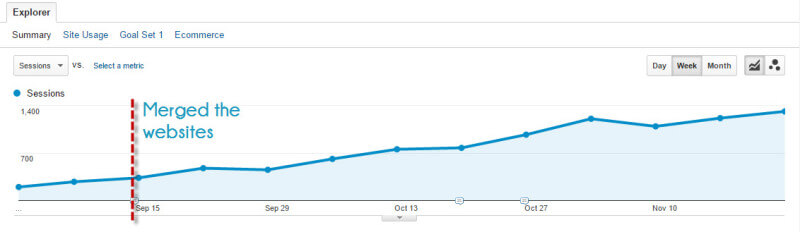
    600% rise in search traffic in under 3 months

    The Logistics Of The Move

    The thought of migrating a website with existing search traffic into another website can be a daunting prospect for even the most experienced SEOs. The reality is that it doesn't need to be such a painful experience if it's managed correctly.

    I've used the same process of migration a number of times with great results. So here's what you need to do:

    Step 1: Migrating The Content

    The first step is to go through all of the content on the newly acquired website to find out which pages are bringing in the most traffic, as well as those that have good backlinks pointing to them.

    A simple way to identify these pages is through using a link analysis tool like Open Site Explorer and navigating to the Top Pages report to see which pages have the largest volume of links pointing to them.

    OSE top pages report

    Alongside this, you can check out Google Analytics (if you have access) to identify the pages on the site that are bringing in the most traffic from the search engines.
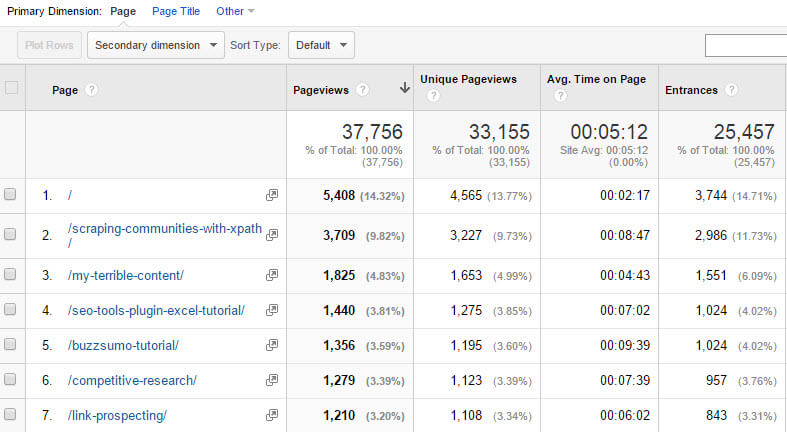
    Google Analytics top content

    Once you've identified the pages that have traffic coming through to them as well as links, it's time to plan out the migration. It's worth noting that you don't need to have a page with tons of links in order to keep it — any links or traffic are good and can be built upon.

    To give a little more perspective, I kept 90% of the content from FindMyBlogWay.com and migrated it to MatthewBarby.com.

    The process of migrating the content is really important; if you do this incorrectly, it could cost you a lot of traffic. Here's how to do it:

  • Identify the content that you want to migrate into your core website.
  • Replicate the new pages within your CMS, adding nofollow tags to them (to avoid duplicate content issues).
  • Ensure that the URL structure is the same or as similar as possible.
  • Within the acquired website, set up canonical tags to point to the new URLs on your core website.
  • Remove the nofollow tags from the migrated content on your core website.
  • At this point, you will still have both websites running live and there won't be any 301 redirects set up. Instead, through the use of the canonical tags, you'll be telling Google that the content on your core website is the original content and this should be indexed over the content on your acquired site.

    If there wasn't any hosting set up for the website you acquired (i.e. it wasn't live anymore), make sure that you set this up as quickly as possible. The last thing you want is to have the pages deindexed. A quick a free solution to this is to use a platform like Hostt that offer free web hosting (yes, that's right, it's completely free!). I use Hostt quite a lot in situations like this because it means you don't have to pay for a month or so of hosting — alongside this, Hostt is actually a pretty awesome service that you should check out if you run a number of websites.

    Step 2: Getting the New Content Indexed

    Once the content has been migrated and the canonical tags have been implemented, the new URLs on your website should start to be indexed and the URLs from your acquired site should start to drop out of the index.

    To speed this process up, create a new sitemap and resubmit it a 2-3 times over the next couple of weeks. This can help to force through a few of the new URLs.
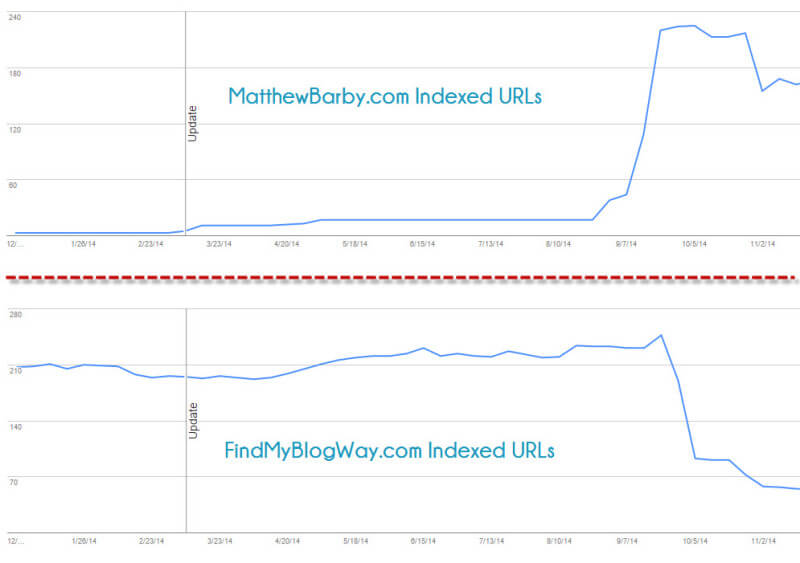
    indexed URLs

    Step 3: Setting Up The Redirects

    After 3-4 weeks, you'll start to see a large majority of the new URLs will have been indexed and the old URLs will have been removed from Google's index (as you can see in the image above).

    Once you're at this stage, it's time to set up the 301 redirects. You'll want to add in a 301 redirect across all of the content that you've migrated — this will pass on all of the SEO benefits that are associated with the acquired website as well as any traffic.

    It's a this final stage that you'll see the main benefits of the acquisition come through. In the coming few weeks you'll see a lot of the search engine rankings start to rise across your website and the extra traffic will start piling through. Due to the fact that the content is relevant to your website, the traffic should all convert fairly well too.

    TL;DR
  • Acquisition is an extremely powerful way to boost your search engine visibility.
  • One of the quickest ways to compete with your competitors is through website acquisition.
  • Identify websites that have potential to grow and some existing links/traffic.
  • Migrate all of the content in a staged approach using canonical tags before redirecting.
  • Some opinions expressed in this article may be those of a guest author and not necessarily Search Engine Land. Staff authors are listed here.

    Learn to Effectively Integrate Marketing Technology At MarTech: The Marketing Tech Conference, we'll connect the dots between technical possibilities and strategic opportunities reshaping of modern marketing. Making those connections will be a roster of innovative thinkers and doers ­- industry-defining executives and analysts who will help you understand marketing technology and its impact on your organization. See the agenda!

    (Some images used under license from Shutterstock.com.)

    Thursday, January 1, 2015

    New Year 2015 Google Logo Says Hello To The New Year With A Bang

    Google 2015 New Years Day logo

    Today's Google logo marks the first day of the year with an animated doodle that transitions from "Google" into "2015″ along with exploding fireworks.

    The logo links to a search results page for "New Year 2015″ and includes a sharing icon so users can post the New Year's Day doodle on their social media pages or send via email.

    Google New Year's Day 2015 doodle

    Last year Google had paid tribute to three women on it homepage, with Google doodles honoring author Zora Neale Hurston, Dian Fossey and Harriet Tubman, all by February 1. By the end of the year, the Google Doodle team had created well over a 100 doodles for its U.S. homepage, with more than 60 featured during the month of June to celebrate the 2014 FIFA World Cup matches.

    Search Engine Land wishes everyone a happy and healthy New Year – may you be as productive as the Google Doodle team!

    Learn to Effectively Integrate Marketing Technology At MarTech: The Marketing Tech Conference, we'll connect the dots between technical possibilities and strategic opportunities reshaping of modern marketing. Making those connections will be a roster of innovative thinkers and doers ­- industry-defining executives and analysts who will help you understand marketing technology and its impact on your organization. See the agenda!

    About The Author Amy Gesenhues is Third Door Media's General Assignment Reporter, covering the latest news and updates for Search Engine Land and Marketing Land. From 2009 to 2012, she was an award-winning syndicated columnist for a number of daily newspapers from New York to Texas. With more than ten years of marketing management experience, she has contributed to a variety of traditional and online publications, including MarketingProfs.com, SoftwareCEO.com, and Sales and Marketing Management Magazine. Read more of Amy's articles. (Some images used under license from Shutterstock.com.)
    Get the best search news, tips and resources, delivered each day.