
Friday, May 26, 2017

How to Get Started With Paid Search [Free Guide]

paid-search-get-started.png

In 2016, 96% of Google's revenue came from paid search (or pay-per-click) advertising. Clearly, marketers are taking advantage of AdWords, but what does a great PPC campaign even look like? How do you ensure it drives ROI for your company? How do you even do a Google AdWords campaign?

To help you get started the right way, we're breaking down the basics of how to use paid search below.

The following is an excerpt from the ebook How to Use Google AdWords, just one of the resources included in The Ultimate Free Google AdWords PPC Kit we created with our friends at SEMrush. The kit includes the full ebook, a template, and a checklist -- everything you need to manage keywords, campaigns and ad groups successfully. If you'd like to access the full kit, click here.

All too often, companies -- small businesses especially -- think that if they just pay to be on a search engine, they don't have to invest time and resources in search engine optimization to rank higher organically. 

It's important to make clear that paid search is not a replacement for anything, but should instead be used to complement other inbound marketing strategies. Paid online advertising takes a lot of time and effort, a lot of resources, and a lot of management, and it's something you really need to invest in.

Let's take a look at some of the useful things you can do with paid search.

Landing Page Testing

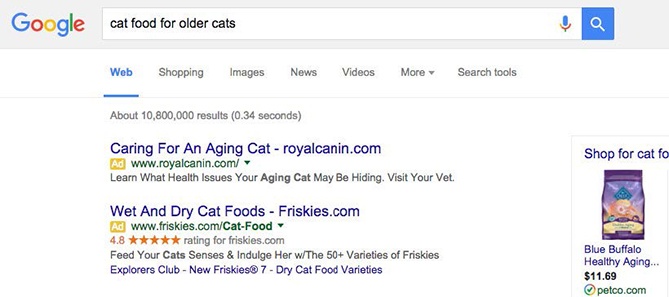
One great way to use paid search is for testing and optimizing your landing pages. So, for instance, here's the search engine results page for "cat food for older cats", and you see some paid results for this specific search query:
EBOOK - How to Use Google AdWords 2.jpg

You can take that one ad and actually set it to go to two different destination URLs, and therefore, to two different landing pages.

So for a cat food ad, you could have one ad going to a page with one offer (a guide on feeding techniques for your older cat), and the other to a page for another offer (an actual product page for cat food).

You could also have the ad go to two different landing pages that are for the same offer. For example, if you wanted to test a feature of your forms, you could have two versions of the same landing page, each with a different form layout, and send the ad to each of those. This is called A/B testing, a very important and highly recommended practice for optimizing your landing pages.

Paid search is a great way to do landing page A/B testing because it allows you to direct traffic to your choice of pages, split this traffic to different pages, and ultimately find the pages that convert at the highest rate.

Finding New Keywords

In addition to landing page testing, you can also use paid search to find new keywords for your campaign. Google AdWords generates a Search Terms report that displays all of the keywords for which your ad has been displayed.

In other words, if you are bidding on the keyword "red shoes", Google might serve your ad when someone searches "red tennis shoes." Even though you did not bid on the exact word, the keyword "red tennis shoes" will be included in this report because that's what the user searched. The report also contains information about the performance of each of the keywords, so you can determine if it's worth adding that keyword to your campaign.

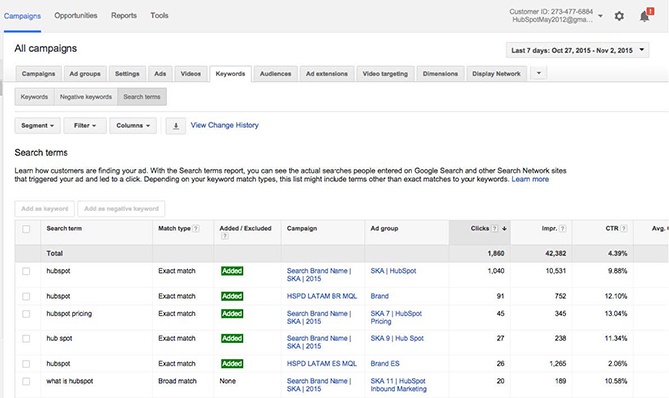
Below is a sample Search Terms report. On the left hand side is the list of keywords. The ones that show the green "Added" box next to them are the ones that are already in this paid search account.
EBOOK - How to Use Google AdWords2 2.jpg

The keywords that don't say "Added" next to them are not currently included in the account. Again, this is a list of the keywords that people are actually typing into the Google search, so it is extremely valuable information.

Take, for instance, the keyword "search engine optimization tutorial'" from the list above. That is an excellent keyword for my campaign, and I'm not buying it yet. Not only that, but I wouldn't have known about that keyword unless I had generated this report! And to top it all off, I'm able to see that when somebody searches for this keyword and clicks through to my ad, they convert on one of my offers at a rate of 21%.

Now, this high conversion rate tells me not only that I should be buying this keyword, but also that maybe I should consider using this keyword for search engine optimization as well. Maybe I should make a landing page geared toward this keyword, or an offer built around this keyword.

You should use the information in these Search Terms reports, and also in Google AdWords' Keyword Planner, to discover new keywords that will help you further optimize all of your SEM campaigns. For more information on keyword research, check out this blog post: How to Do Keyword Research for SEO: A Beginner's Guide and the Ultimate keyword research checklist.

Getting in the Game

Another great way to use paid search is to, as we say, "get in the game" and rank higher than your competitors. Let's look at PetSmart.com, which holds the number one ranking in the organic search results for the phrase "cat food".

For the phrase "dog food", they don't rank number one, but they're still above the fold, meaning that you don't have to scroll down to see the result when the page comes up. This is great, of course, but their high rank for these keywords does not mean they shouldn't bother running any paid search ads.

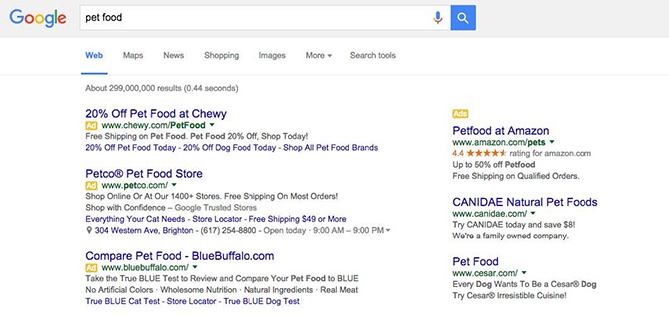
If you do a little research, you'll find that "pet food" is also a big keyword in this space, and PetSmart ranks far below the fold for it. On top of that, they're not running a paid search campaign with Google AdWords either. But their competitor, Petco, does have a paid search campaign, and so their ad appears on the results page, while PetSmart does not. So this is a sample instance where running a paid search campaign makes a lot of sense.
EBOOK - How to Use Google AdWords4.jpg

Paid Search Can't Stand Alone

When you think about how you should use paid search, one of the best ways to think about it is to use it as a complement to your inbound marketing efforts. You can use paid search to maximize your coverage on the search engine's result page (SERP).

For instance, here we have the search term "inbound marketing." You'll see that there's an organic search listing for HubSpot that ranks second on the page (just after Wikipedia), but we're also buying the keyword "inbound marketing," which displays our paid search ad for it.

So now we have that natural search ad, the paid one, and, if you scroll down the page, you'll find yet another organic search listing for HubSpot via SlideShare. This widespread coverage on the search engine results page for "inbound marketing" helps to establish HubSpot as an authoritative figure for inbound marketing, and drives more traffic to our pages.

The good news is -- you can do this for your business as well! Take the opportunity to establish your company as a leader in your industry by increasing your presence on search engines with paid search campaigns.

Ready to get started with the full ebook, template, and checklist? Click here to access the complete Ultimate Free Google AdWords PPC Kit. 
New Call-to-action
Source: How to Get Started With Paid Search [Free Guide]

Thursday, May 25, 2017

#SEO Trends 2017

SEO Trends 2017 From the middle of 2016, we had many predictions about the future of SEO in 2017. Now we are standing in 2017 and it's time to consider which trends will push SEO towards which direction. So far, we have listed five current trends, which were predicted ... read moreUnderstanding The Top SEO Trends For 2017 If you want to make sure that your blog or website is going to stand out from the rest and rank well within the search engines, you will need to stay on top of the SEO (search engine optimization) trends that will be gaining some force behind them ... read moreWe Surveyed Hundreds of SEOs and This is What We Found Thus, the AWR 2017 SEO Stats Report maps out behaviors and trends among freelancers, in-house marketers and agencies. The main driver of the survey was finding out how professionals like you do their work, and for that we tried to formulate the most ... read more

SEO Tips For Beginners: How To Drive Organic Traffic In 2017 However, some of the trends that worked in 2016 would continue to be effective ... 76 percent marketers make use of the social media to support as well as boost their SEO efforts. In 2017, the use of the social media will be much more than the previous ... read moreDemystifying Search Engine Optimization (SEO) in 2017 Let's take a look at some of the latest and greatest SEO advancements that'll change the game in 2017. Ever clicked through a result ... adjusting their methodologies based on the latest trends. read more7 Blogging Ideas For When You're Stuck, Tired And Can't Write A Thing Also, be as specific and positive as possible. Instead of writing '13 SEO Trends To Watch Out For In 2017′, try '13 Things Your Business Should Be Doing For SEO In 2017′. But following influencers, industry and thought leaders, as well as daily ... read moreFeature: NJ SEO's Matt Anton on Keeping Up with SEO Trends It's interesting to know that Google in 2017 has moved from naming its SEO algorithm updates ... Matt and company have an intimate understanding of what it takes to stay abreast of SEO trends, and have been involved in the SEO and software services ... read moreThe State of Healthcare Content Marketing in 2017 Ultimately, the state of content marketing in 2017 appears to be strong and should grow ... social media marketing, and SEO. To learn more about the latest trends in healthcare marketing, contact MDG Advertising today at 561-338-7797 or visit ... read more3 SEO Trends That Matter In 2017 From mastering the basics of local SEO optimization to keeping tabs on Google's ongoing algorithm changes, staying on top of SEO trends is enough to give any brand whiplash. Trust me. I've seen it. And it ain't pretty. Sure, your company has covered ... read more7 Most Important SEO Techniques Not to Leave in 2017 2017 promises some new and some old trends surfacing for Title tags ... value locked in your internal pages will optimize your ROI and you can derive sustained SEO benefits from your old content. Deep linking between pages also reduces the bounce rate ... read more

Buy AutoTrafficRSS script now for $27 only!

We will send the script to your PayPal email within few hours,Please add FullContentRSS@gmail.com to your email contact.
Source: #SEO Trends 2017

Yardi Introduces RENTCafé Reach Advanced Property Marketing Services

May 25, 2017 --

SEO, SEM and enhanced online listings help multifamily property management companies stand out and attract more renters

SANTA BARBARA, Calif.--(BUSINESS WIRE)--Today Yardi� announced the addition of a new marketing offering for residential property management. RENTCaf� Reach includes an advanced set of marketing services designed to attract qualified prospects to multifamily properties through search engine optimization (SEO), search engine marketing (SEM) and enhanced online property listings on RENTCaf�.com.

Property marketers can use RENTCaf� Reach to maximize the visibility of their properties in search results, no matter how renters are searching.

  • Increase organic traffic with SEO. SEO services build authority and increase search engine ranking with on-page and off-page optimization, full site audits and monthly analytic reporting.
  • Drive targeted leads using SEM. Create effective pay-per-click advertising campaigns in minutes and give properties an immediate marketing boost with help from Google AdWords Certified Specialists.
  • Expand reach with enhanced listings. Automatically showcase listings on RENTCaf�.com, the only search platform where renters can find an apartment, apply and sign a lease completely online.
  • Previously available to select clients, RENTCaf� Reach has already driven success for multiple brands. One company recently reported a decrease in bounce rates and 32% increase in organic traffic portfolio wide.

    RENTCaf� Reach is part of the Yardi Marketing Suite, a mobile system that supports the entire prospect and resident lifecycle. This integrated range of solutions and services cant be found elsewhere in the industry through a single vendor.

    ?Everyone knows the way to reach renters today is online, but prospects are finding properties in multiple ways. With vacancy rates edging upward, property marketers need to stand out in todays highly competitive digital marketplace to win more customers. The three distinct services available through RENTCaf� Reach allow our clients to maximize their impact at every level of the search process, said Mark Klionsky, director of RENTCaf� Marketing Services at Yardi. ?Complete integration with their existing property marketing platform yields total transparency and measurable results.

    Contact us to learn how you can increase web traffic to your rental properties.

    About Yardi

    Yardi� develops and supports industry-leading investment and property management software for all types and sizes of residential and commercial real estate companies. Established in 1984, Yardi is based in Santa Barbara, Calif., and serves clients worldwide. For more information, visit yardi.com.

    Contacts

    Yardi Systems Inc.Leah Etling, 800-866-1144 x1207Leah.Etling@Yardi.com

    Related Keywords:

    Source:Copyright (c) Business Wire.. All Rights Reserved


    Source: Yardi Introduces RENTCafé Reach Advanced Property Marketing Services

    Wednesday, May 24, 2017

    Tasty #SEO Report #Recipes to Save Time & Add Value for Clients [Next Level]

    Tasty SEO Report Recipes to Save Time & Add Value for Clients [Next Level] | Latest News

    Buy AutoTrafficRSS script now for $27 only!

    We will send the script to your PayPal email within few hours,Please add FullContentRSS@gmail.com to your email contact.
    Source: Tasty #SEO Report #Recipes to Save Time & Add Value for Clients [Next Level]

    Crafting a successful holistic search approach

    Sign up for our daily recaps of the ever-changing search marketing landscape.

    Now more than ever, brands are looking to maximize ROI for their marketing spend. Yet when discussing holistic search strategy and planning, I often get: "Everyone talks about holistic search, but no one's doing it." This always surprises me for three reasons:

  • Both paid and organic search are targeting the same consumer.
  • Holistic search strategy and planning is very straightforward to implement.
  • It can maximize both performance and efficiency.
  • For these reasons, holistic search should be a central part of any campaign. Below are the five areas that I believe are essential to crafting a successful holistic search approach.

    1. One purchase funnel, one shared keyword set

    Understanding the consumer and their search behavior is essential. This provides the insight that allows us to build a comprehensive picture of both the path to purchase and the consumer's informational needs at each step of the purchase journey. From here, key topics and themes can be identified and extensive keyword lists developed.

    Keyword research is often an area of duplication across both paid and organic channels, resulting not only in an inefficient use of time, but also varied keyword sets across the purchase funnel. A holistic approach eliminates these issues.

    With a detailed purchase funnel and shared keyword set in place, performance across paid and organic search can be mapped out with the coverage gaps highlighted.

    2. Optimize overall search performance

    With the coverage gaps identified, they can be prioritized based on search volume, competition, purchase funnel stage and contribution to sales. If the gaps sit toward the top of the funnel, the search terms may not be direct sales drivers but will drive significant traffic volume; consumers research their purchases, which in turn increases the likelihood of making it onto the consideration set and fueling sales growth later in the purchase journey.

    At this stage, position within the funnel, combined with short-term versus long-term growth targets, plays a key role in channel focus. For short-term growth, paid search should be deployed for instant impact to build search visibility. However, if focusing on mid- to long-term growth opportunities, paid search can be tested to validate the viability of the relevant keyword group. If the test proves successful, an organic search campaign can then be deployed to develop overall search visibility.

    3. Share performance insight for quick wins

    Cross-channel insights provide a wealth of quick wins that can drive incremental performance gains. Paid and organic search teams should be analyzing and discussing performance on a continuous basis, exploring areas such as:

  • top-performing ad copy. What learnings can be applied to increase CTR?
  • keyword performance. Are there any high-performing keywords where either paid or organic search has limited coverage?
  • landing page performance. If separate paid media landing pages are in place, how do conversion rates compare to organic landing pages? What learnings can be taken from the top-converting pages, and how can these fuel UX and CRO testing?
  • 4. Create a measurement framework

    It's vital to look at search holistically to understand the impact of each channel on overall search performance. It is even more vital that this is done using a single data source, i.e., site analytics, to ensure fully de-duplicated data. At a minimum, the measurement framework should review traffic and conversion performance by channel and for search in total.

    Brands often review performance for paid and organic search in silos; thus, performance increases and decreases are taken out of context. For instance, if a competitor starts bidding on brand terms, triggering a response to protect performance, this could reduce organic search performance but maintain overall performance.

    It is important to ensure both paid and organic search teams are using consistent reporting data to ensure the dots are connected across channels.

    5. Communication and process

    Communication and process are the absolute key to a successful holistic search approach. If paid and organic search teams aren't collaborating and discussing performance on a daily, weekly and monthly basis, then failure is guaranteed. In contrast, if there are clear processes in place with regular catch-ups, then the right data gets analyzed and the best insights surfaced. This will drive performance gains for search overall.

    In summary

    Implementing a holistic approach is essential for driving overall search performance. By fostering collaboration across paid and organic teams to develop a single consumer-centric planning process and measurement framework, we can increase efficiency and make better, more data-driven decisions. However, it is communication and process that will ultimately dictate the success of the holistic approach.

    Some opinions expressed in this article may be those of a guest author and not necessarily Search Engine Land. Staff authors are listed here.

    About The Author David, is Business Director – Owned Performance at Ecselis, Havas Group and is responsible for leading and developing their propositions and service solutions, specifically around SEO, Content and CRO in-order to deliver long term strategic results for clients. David has over ten years' experience in delivering business growth across start-ups to multi-national enterprise level clients, as well as launching brands' web presence in new markets. Having worked client side across paid, earned and owned media and held senior SEO agency side roles, David brings thought leadership from multiple viewpoints and a leading performance-driven approach. David was named the 12th most influential search marketer in The Drum's Search Top 50 in 2014. In addition, David speaks at conferences such as SES and Search Leeds.
    Source: Crafting a successful holistic search approach

    Tuesday, May 23, 2017

    5 Ways To Increase #SERPs For Your #Website Today

    5 Ways To Increase SERPs For Your Website Today High quality links with high trust flow and diverse domain is still a great ranking factor for Google search engine. Earning links and finding ways to extend your reach through link building should never be overlooked, especially when you already have a ... read more10 Scientifically-Backed Ways To Increase Sales By Making Your Website More Credible 5. Profile the people behind your company People want to know they're dealing with other real people. On your about page, add photos and bios of your key employees to show the faces behind your brand. Another way ... will increase your website's ... read more5 Proven Ways For Driving Traffic to Your Website With Visual Content Driving traffic to your website ... way. What would be more effective for your learning; Watching a video tutorial or reading it? Watch this video and make your own judgement… Let's now have a look at the 5 best visual ways for increasing website ... read more

    5 Tweaks to Your Website That Could Increase Sales 300% This article is part of SWOT Team, a new series on Mashable that features insights from leaders in marketing, brand-building and public relations. A company website is a must-have in today's Internet ... the potential to increase your revenue by 300% ... read more5 Ways to Practice Self- Compassion After Loss Here are ways to practice self-compassion. After the death of a loved one, you know grief doesn't subside with time. Your level of anxiety and pain may actually increase as time ... and can be reached via her website. She speaks about resiliency ... read more10 Things You Can Do Today to Increase Website Sales The same can be said for those who want to increase the number of sales generated from their website. But as Beverly Sills said, "There are no shortcuts to any place worth going." Luckily, there are a few ways ... tips on your website today and simply ... read more5 Research-Backed Strategies to Increase Your Sales Revenues Use security seals: Research shows that displaying security seals on your website is the foremost way to get people to trust and buy from you. Simply embedding a familiar security seal will go a long way to increase ... render in today's "everything ... read more5 Easy Ways to Make Sure Your Website Actually Works for You Don't over-email, though, emailing too often is the surest way of encouraging unsubscribes. 5 ... today." There are almost 2 billion websites on the internet today and high competition in all areas. If you aren't doing your level best to optimize your ... read more5 Ways to Use Psychology to Increase Social Engagement Understanding how your customer's (and your own) brain works can help you provide better content and increase social engagement. Because of all that ... use them to increase your social engagement and website sales. Ready to pick apart the brain? read moreDownload Speed: 13 Ways to Increase Your Internet Speed Today Check out your router and ISP's website for the best settings ... in my roof were almost totally chewed away and needed replacing. Do you know any other ways to increase your internet speed? I would be really interested to hear them. read more

    Buy AutoTrafficRSS script now for $27 only!

    We will send the script to your PayPal email within few hours,Please add FullContentRSS@gmail.com to your email contact.
    Source: 5 Ways To Increase #SERPs For Your #Website Today

    5 reasons why websites still matter to local search in 2017

    Why are we still having this discussion? Because data show that a surprising number of businesses still don't have a website. Surveys from as recently as October 2016 find that close to half of all small businesses don't have a website, and it's not just solo work-from-home moonlighters, either.

    Specifically, a Capital One survey of 400 small businesses  — its Fall 2016 Small Business Barometer Survey — found that only 56 percent have a company website. And only 53 percent of those were mobile-optimized. In other words, fewer than 30 percent of businesses surveyed had a mobile-optimized website.

    Further, there is a fair argument that websites are no longer as effective in the local market. Technology and cost certainly are no longer barriers given the availability of subscription options for even the least sophisticated users and slick DIY platforms for those who don't want to hire a freelancer or agency. Instead, the challenge is that websites must compete for relevance in a market with many other media platforms — social media sites, directories and review sites — that are often viewed as proxies for the face of the franchise.

    Today, social media is dominating SMB attention, a survey conducted by the Local Search Association (my employer) has found. Almost 43 percent of SMBs surveyed said that it would be the media of choice if they could only select one form of online marketing to use. That was the top choice by a large margin, with SEO ranking second at 25.6 percent. This preference explains why social media pages such as Facebook pages are increasingly used as the primary public-facing "landing page."

    Other "proxy" home pages include directory listings that are sophisticated enough to contain virtually all the key information customers are looking for. Third-party sites can integrate multiple functions such as e-commerce, online booking and reviews and attract a bigger and broader audience than an individual website. And even Google profiles, knowledge graphs and snack-pack listings can suck huge amounts of traffic away from a website.

    All in all, median click-through-rate (CTR) from a #1 result on Google is down 37 percent over the last two years, according to a study by Wordstream. That seems like pretty strong evidence fewer people are visiting websites and are instead relying on other media.

    While these reasons are seemingly enough to persuade some that third-party-owned pages are a sufficient and simpler alternative to maintaining a business website, other data reveal a different story. Below are five reasons why every business needs a company website for local search marketing.

    1. 63% of consumers use websites to find or engage with businesses

    According to LSA's (Local Search Association) April 2017 report, "The Digital Consumer Study," that examined digital media use in 12 US cities, websites were the second most-used media to find local businesses. Only two forms of media were used by the majority of consumers when looking at "past week" usage trends: search engines and company websites.

    Consumers use websites to find or engage with businesses 63 percent of the time. And while the perception is that the variety of media available to consumers would decrease website use, LSA's numbers show something different — 2016's weekly website usage rate of 63 percent was an increase over 2015's 60 percent rate.

    These numbers show that despite the growth of other media, the value of websites has not diminished – in fact, it continues to grow. While Wordstream's study showed a decline in CTR from Google SERPs (search engine results pages), consumers are finding and clicking through to business websites from other sources such as Yelp, YellowPages.com and Google My Business listings.

    2. The top 10 local organic factors for SEO are related to websites

    Only 5 percent of consumers surveyed by BrightLocal in 2016 never used search engines to find local businesses — which means 95 percent have. And 69 percent reported searching for a local business at least six times per year. So SEO is a big deal.

    According to Moz's 2017 Local Search Ranking Factors, the top 10 factors for appearing in organic Google search results are related to a business's website or domain. These factors include how authoritative your website is, based on who is linking to your site, how many third parties are linking to you and the quality and relevance of your content, to name a few.

    While arguably, these factors can be fulfilled on a Facebook page, realistically, that doesn't happen. For one thing, a major factor — authority of the site — is difficult to achieve on a social media site, since Google doesn't consider social signals such as likes or followers in weighing influence. I performed a few test searches on Google of snorkel gear, ski equipment and pool supplies in Plano and Frisco, Texas, and found only two Facebook pages of local businesses — and they were deep into the search results. In both cases, the Facebook pages appeared many results after the respective websites of those businesses.

    Note that I'm not talking about searches in which a business's name is specifically typed into the search box. Those results commonly return Facebook pages, Yelp listings and Groupon offers. However, since finding new customers is the top marketing priority for businesses, according to a Unity Marketing survey last year, businesses can't count on folks who already know their name and proactively search for it.

    Maintaining a website that has quality and relevant content that is consistently referenced and linked by other reputable third-party directories, sites, articles and posts is critical to being found when customers conduct research online and are looking for products and services to buy.

    3. Local snack-pack and Google map results are influenced by websites, too

    According to Moz, the biggest impact on local pack ranking factors is your Google My Business (GMB) profile and the proximity of your business to the searcher. Yet having a complete and rich GMB profile does not guarantee you will show up in Google local finder or map results. Businesses often make the mistake of assuming that you'll automatically show up in searches for your business category (as listed in your GMB profile) in your geographic area.

    Despite the fact that proximity, physical address and GMB business category rank 1, 2 and 3 in Moz's local pack ranking factors, Google often lists businesses that are not in the initial search area while omitting results that would otherwise match the search, deeming those other results more authoritative. It's not just new or small businesses that are affected, either; big brands can struggle with this, too.

    Some of the factors that affect organic SEO rankings — such as backlinks, domain authority and clicks — are also essential to ranking and appearing in Google local finder and map results. Also, I've found that having location-based information on your website and linking to that source from your GMB profile can help boost local search results.

    4. 30% of consumers won't consider a business without a website

    Just because someone looks at your Facebook page or reads reviews on Yelp doesn't mean they don't also want to see your website. In fact, consumers typically rely on multiple sources to gather information before making a purchase decision.

    Research by YP and LSA found that, on average, consumers use approximately three sources before making an individual purchase decision. And 30 percent automatically strike a business from consideration if they don't have a website.

    Thus, those businesses that don't have a website experience a significant loss of ready-to-buy, high-intent potential customers.

    5. 46% say a website is the biggest determinant of whether they trust a company

    Consumers may find you on Facebook, Google Maps or Yelp, but one big part of your online reputation comes from your website. Research conducted at Stanford in 2002 (PDF) found that 46 percent of consumers made their decision about a website's credibility based upon its design, layout and typography.

    Listings may provide business details, and reviews give other customers' opinions, but on a website, prospective customers hear directly from you about you. Facebook and other social media provide a partial view of your business, but the ability to personalize the design is extremely limited, and your information is presented in a format that's the same for everyone.

    A website is a storefront that reflects your identity and allows your consumers to form opinions on the quality of your products or services, the trustworthiness of your business and whether you are someone they want to buy from. It is especially important for services. According to a study from the e-tailing Group and Oracle (PDF), 75 percent of consumers say the quality of product images is essential in selecting and purchasing products online. For services, a website is your product image.

    Closing thoughts

    It may seem easy as marketers and agencies to just do what our clients want. Yet marketing decisions that SMBs make may be based on incomplete or out-of-context information. For example, an SMB may look at the time consumers spend on social media and quickly conclude that its marketing resources should be spent in proportion to that social media use. Or an SMB may make an even bigger mistake and decide that it can rely solely on social media.

    I'm not bashing social media as a marketing tool. However, it behooves us as marketers to educate our clients and make sure they understand the context of data they use to make decisions. We should help our clients look deeper into consumer trends and come away with better insights to make good decisions. One of those is to avoid sacrificing websites in favor of social media or other media in local search marketing. Websites remain a critical part of local search and are essential for attracting the customers necessary for business growth.

    Some opinions expressed in this article may be those of a guest author and not necessarily Search Engine Land. Staff authors are listed here.

    About The Author Wesley Young is the Local Search Association's Vice President of Public Affairs. He blogs about the industry on the Local Search Insider blog.
    Source: 5 reasons why websites still matter to local search in 2017