
Buy AutoTrafficRSS script now for $27 only!
We will send the script to your PayPal email within few hours,Please add FullContentRSS@gmail.com to your email contact.Source: #SERP Logic Subscriber Levels Pass 10,000 Milestone as 2016 Begins
Buy AutoTrafficRSS script now for $27 only!
We will send the script to your PayPal email within few hours,Please add FullContentRSS@gmail.com to your email contact. SOMEREN, NETHERLANDS-Jan 21, 2016 -Any website owner looking for professional SEO services has just been offered a unique opportunity to enjoy first-rate services at a bargain. This is thanks to an announcement recently made by Guillaume Van De Laar - an experienced SEO consultant. Van de Laar recently announced the launch of his SEO agency website.
The website,http://www.guillaumevandelaar.nl, is intended to offer first-rate SEO services to any website owner who desires them. These services include search engine marketing, website design & optimization, internet marketing, search engine optimization, and other SEO support services.
According to Van De Laar, the SEO services are designed for those who desire to maximize their website rankings. As such, his SEO company employs the latest white-hat SEO strategies in order to achieve the best website ranking on all major search engines including Google, Yahoo, and Bing.
Each service provided by Guillaume is tailor-made to suit the specific needs of a website owner. The ultimate goal is to provide every website owner with an opportunity to achieve the maximum rankings in their niche.
The services take a holistic approach to SEO. This means that a website is optimized to attain maximum rankings on three fronts, i.e. desktop-based searches, mobile searches and local searches. The end result is that a website is competitive on all fronts - thereby ensuring maximum visibility on the web.
According to Van De Laar, motivation for providing holistic services arose from observations he made during his years of work as an affiliate. While providing affiliate services, he noticed that most service providers focused on singular SEO services.
As a result, a website would achieve first page rankings on desktop-based searches, but not appear on the first mobile SERPs. This would prevent a website from achieving its full SEO potential.
Guillaume therefore decided to move from affiliate marketing services to providing SEO services. His motivation was to provide his clients with holistic services. As such, besides direct SEO services, he also provides a host of support services. This includes SEO audits, monitoring and consultancy. The website also provides important SEO tips and strategies which website owners can use to boost their website rankings.
Ultimately, Guillaume can enable every website owner to achieve maximum search engine rankings for their website. This can ultimately give the website exposure, and increase its chances of achieving its goals.
The best part about Guillaumes services is that they are currently being provided at a discount. This is a limited-time offer announced to commemorate the launch of the website. The discounts mean that website owners can access Guillaumes SEO services at a bargain. This is an opportunity which no website owner should miss.
Whoever desires to sign up for Guillaume Van De Laars SEO services, or find out more about them should visit the recently launched SEO agency websiteGuillaumevandelaar.nl
About Guillaume Van De Laar
Gullaume Van De Laar is an SEO consultant with years of experience in providing SEO services. His areas of expertise include search engine marketing, search engine optimization, local SEO, and internet marketing. Van De Laar honed his skills offering affiliate services to a lot of successful SEO companies. He recently launched his SEO agency website in order to provide first-rate SEO services to his clients.
More information on his services can be found on theGuillaume van de LaarSEOagency website.
Full News Story:https://pressreleasejet.com/newsreleases/2016/guillaume-van-de-laar-launches-seo-agency-website/
Distributed by Press Release JetMedia ContactCompany Name: Guillaume van de Laar SEOContact Person: Guillaume van de LaarEmail: info@guillaumevandelaar.nlPhone: +31-493-782 783Country: NetherlandsWebsite: http://www.guillaumevandelaar.nl
Source:Copyright (c) AB Digital, Inc. All Rights Reserved
Buy AutoTrafficRSS script now for $27 only!
We will send the script to your PayPal email within few hours,Please add FullContentRSS@gmail.com to your email contact.Last week the IAB UK revealed that over half of all brands are buying mobile inventory using programmatic media buying technologies, but less than half (45 per cent) understand how the technology actually works. Online advertisers spend billions of pounds on programmatic advertising every year, but it seems they understand very little about how programmatic buying actually works.
Not too long ago, search engine marketing was an "experimental" marketing channel that only a handful of companies were willing to test out with spare marketing budget. However, somewhere around 2007, search became a primary source of revenue for most online businesses and the introduction of Product Listing Ads moved search marketing to the forefront of their online marketing strategy. Today, you'd never meet an e-Commerce company who isn't deeply invested in their search strategy.
In the same way that search marketing skyrocketed to the top of every online marketer's priority list, we are now on the cusp of a programmatic revolution. However, many retail brands remain at arm's length from their programmatic ad strategy, with only a partial understanding of the data that is powering their campaigns. As we enter a major turning point in the world of digital marketing, e-Commerce brands need to understand exactly the why, what and how to programmatic.
Why is "programmatic" so confusing?Programmatic advertising is simply the automated process of buying and serving of targeted ads, using data-driven systems. The ultimate goal is for the advertiser to reach the perfect shopper, at the right place, at the right time and with the right message.
The programmatic industry is constantly growing and evolving and with it, a slew of confusing advertising tech jargon has emerged and 'Programmatic Advertising' has become a catch all phrase for a few different concepts:
In the retail world, the path to purchase is becoming increasingly complex, but marketers are now acknowledging the many touch points present in the path to purchase, each of which have their own contributing effect on the consumer's decision to buy.
However, this process is extremely hard to measure. That is why most major retailers manage their programmatic advertising work with agencies, as they are equipped with the right software, data and experience to provide results without the overhead.
That being said, it's still crucial that e-Commerce brands understand the data that is powering their programmatic campaigns and whilst for some, search marketing has become part of the company's marketing DNA, many advertisers are comparatively lagging when it comes to incorporating programmatic into their marketing strategy.
The areas that retailers need to ensure they give enough attention to are:
First-Party DataMany retail brands recognise the importance of their first party data, but they fail to make the most of it. Your most powerful data is often your own—and best of all, it's free.
Retailers should be proactive about aligning their marketing teams around data and programmatic initiatives. Consider creating a Data Task Force responsible for locating and consolidating your data stores—such as CRM data, browsing data, email segments, app downloads, conversion data, rewards members etc.—into a DMP so that your agencies and partners are able to utilise it in real-time.
The more your agency knows about your own shoppers and buyers, the more effectively they can retarget them and model new audiences off your most engaged customers. Work with your agency to determine what first-party data is most useful to them.
New or Third Party DataMost likely, the agency or partner that manages your programmatic media is modelling or purchasing audience data to power their advertising efforts.
If they have a limited amount of data and need to broaden the reach of your campaign, they may "model" an audience from your known buyers (your first-party data). This means that they will find other shoppers with similar attributes or behaviours to people who have purchased from you before.
Modelled audiences are great for targeting shoppers who have not considered you before, but are (hopefully) likely to do so. However, if your goal is to hit shoppers who have previously expressed interest in purchasing a product, then you may want to focus on observed audiences, who consist of people who have actually engaged with a product page or purchased a specific item before.
Another way to think about this data is by looking at shopper interest vs. intent. Interest data may reveal that John read an article about "The Best Golf Clubs of 2015," but intent data shows that John was shopping for Irons and Drivers this morning.
These distinctions may not be immediately obvious on the platforms where data is bought and sold; it's important that you ask your agency to elaborate what kind of data they are using, and ensure that it's aligned with your online marketing goals.
In summary: the 5 simple questions to ask your agency
MarieDalton
Contributor
Marie Dalton, Marketing Director EMEA at Connexity
Buy AutoTrafficRSS script now for $27 only!
We will send the script to your PayPal email within few hours,Please add FullContentRSS@gmail.com to your email contact.Does the world really need another metric to measure performance? Unfortunately, I think we do, as one of the biggest issues in marketing is a lack of agility. We need new metrics to help speed up our reaction times.
With that in mind, allow me to introduce 'EvE', which is a loose, ill-defined, highly immature real-time marketing metric. I'd love some feedback as this is very much a work in progress.
EvE is a measure of how much bang you're getting for your buck. You want maximum bang for minimum buck. In most cases, time is money, and effort / time can be measured in cold hard cash. Are your efforts paying off? Is there anything you can do to ensure success?
I've always had some sense of whether the thing I've worked on has underperformed, or outperformed, and increasingly I monitor this in real time, mainly because it's possible to do so. I'm really just trying to figure out if something was worth the effort.
I instinctively use 'EvE' thinking primarily to measure content marketing, but it applies to marketing more broadly, as well as things like conversion rate optimisation, and UX. In fact, it applies to all kinds of things.
EvE could also apply to that three-course meal you're going to lovingly prepare for your dinner guests. If it goes right, you'll hear a lot of comments about how delicious it is, and how lovely it smells, and how did you make it, and where did you find such incredible ingredients, and oh we must really come over more often!
If it goes badly, there will normally be a few polite murmurings, and then silence. You'll wish you just ordered pizza. Cooking really wasn't worth the bother, nor the expense, and you could have spent the afternoon doing something else.

That's EvE in a nutshell. You want people to come over more often and to say nice things about your efforts, and to feel like it was a worthwhile endeavour.
It's a bit like that in business, don't you think? You want lots of repeat customers who do your marketing for you by becoming advocates, and recommending your products and services (the most powerful form of marketing there is).
Why we need something newThere are dozens of ways to measure success, but many of them are lagging indicators. In other words, they reflect the state of play once the results are in. This is all very well, but we need more leading indicators in our lives.
Leading indicators help us to predict future success, or warn us about imminent failure. All kinds of leading indicators are used by goal-orientated people to see if they're on-course, or heading for the rocks. They give us the opportunity to react.
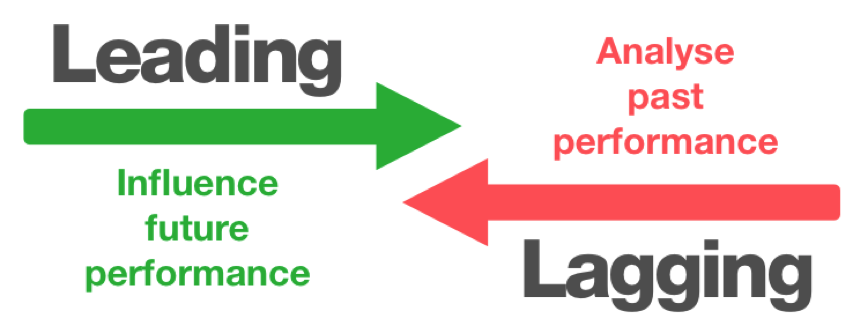
EvE is a blend. It is one part lagging indicator ('effort') and one part leading indicator ('engagement'), but over time I think it will become much more aligned to the latter, as engagement (which is broadly a synonym for 'performance') can be measured in real-time.
For example, if this post achieves a certain number of social shares within a certain timeframe then I know it will be a hit, relative to other posts on this site. I also know that it will continue to attract shares (and page impressions, and comments, and new inbound links, etc) in the days and weeks ahead.
If, however, things go the other way, I can consider doing something about it. I could do some paid social, or get in touch with some of my influencer buddies to spread word. I could push it around to relevant link sharing sites. I could start a fight with somebody who I know will disagree with it. I could create a visualisation to explain EvE in less than 1,000 words. I could spin it out into other content formats, such as slideshows, webinars, videos, etc.
And so on.
Building momentumWhat we're really talking about here is engagement velocity. EvE seeks to measure engagement velocity in real time.
Content is 'alive' for a while, and at some point it will naturally fade out. Or at least that's how it should be. If you're busy creating content that doesn't reach the average lifespan of an article, then you seriously need to consider whether it was worth the effort. Lifespan can be measured in impressions, comments, shares, downloads… whatever floats your particular boat.
You also need to spot the outliers and learn from them. Figure out why certain blog posts or videos outperform. More importantly, take a look at the ones that underperform, especially if you're spending a lot of effort on them. If they don't have a tactical value, then is it worth investing in any more of them? Remember that as the amount of effort increases, so must the engagement.
The EvE metric, if used in real-time as a leading indicator will help you spot whether or not something needs – or merits – a push. You can use it to predict performance, considering how something should be performing at any given point.
Sometimes you need to light a fire underneath your efforts. If you spend a month working on a new piece of content (or marketing campaign, or product feature, or 72-course dinner for your guests) then hopefully it will be good enough to attract enough attention to merit the effort. But, if needed, you can go the extra mile to promote it, unless it's clearly a dud.
This is why EvE is different from ROI. It is meant to be more fluid, and less final. Real-time marketing is all about agility, and if you track EvE you should be in a position to move the ROI needle.
Calculating 'EvE'I don't want to be too prescriptive with regards to scoring systems, but suggest that you can use absolute numbers, points, weighted averages, and multipliers to come up with some meaningful figures.
The key is to know a few things in advance. All of these things can be baked into your calculations.
Effort
Cost is the primary – and most straightforward – measure of 'effort'. When you're ready to release a new piece of content you'll have a pretty accurate sense of how much it cost. At this point, you've invested what it takes to produce and edit the content, and as such you'll know what it takes for that effort to pay off. Cost is more easily measured when using freelancers, agencies and contractors.
Time spent seems straightforward on the face of it, and is an alternative to cost (though you can use both). Time is inherently linked to cost, but is perhaps more useful for evaluating the efforts of in-house teams, especially if you don't want to get into proportionate salary calculations. Was it worth spending an hour, a day, a week or more on that thing? Worth it, as in, should you do it again?
Output is the thing that was produced. Everything is relative. Different content formats have different costs, on average, and they perform differently. A video should be compared with a video, a blog post with a blog post. Adjust your benchmarks, targets and goals accordingly. It's worth adding that some things are more aligned to your macro goals than others.
People. This follows on from 'time spent'. What was the opportunity cost of that particular person doing that particular piece of work? What else could they have been working on? It is crucial that you use your team wisely, especially your star players.
Engagement
Targets. How will you know if you're on track? For content, real-time targets might be things like concurrent users onsite, or impressions or comments, or shares or likes, or influencer mentions, or inbound links, or downloads, or leads. What is par, one hour, one week, or one month after publication?
Goals can be strategic or tactical. This is very much a case of horses for courses. You'll need to figure this out for yourself, thinking about the ultimate goals of your business. How is the thing you've worked on contributing to those goals?
You can track all of this stuff as it happens, and react as necessary.
A scoring frameworkI think the best way to measure is EvE is to put together a scoring framework, based on average costs (effort) and average performance benchmarks (engagement). The higher the EvE score, the better.
EvE score = engagement divided by effort
A blog post might be given an effort score of 100. The effort reflects time and cost to produce the post, relative to other outputs (e.g. video = 500, whitepaper = 2,500, etc).
For that blog post to break even, it must also achieve an engagement score of 100. This is the anticipated performance, and value, relative to similar content. In other words, the goal.
Its EvE score is engagement divided by effort. In this case, that's 100/100, which gives it an EvE score of 1. And that's okay, because 1 is par.
The effort scoreUsing the above examples we can compare different outputs. A video costs five times as much effort to produce, vs a blog post. A whitepaper costs five times a video, and 25 times as much as a blog post in effort.
However, these are averages. 100 points is the average effort score for a blog post. That might be akin to three hours of a freelance writer's time.
It could be that the same writer puts together a post in half of the time, and charges you half the fee. We can halve the effort score to reflect that.
The engagement scoreLet's say an average blog post pulls in 5,000 impressions. If a post hits that mark we can award it the full 100 points, and an EvE score of 1 (100/100 = 1).
If it underperforms and reaches just 4,000 impressions then it gets just 80 points, and an EvE score of 0.8 (80/100).
But let's say it only took half the time to produce. We halve the effort score (to 50) and the EvE score rises to 1.6 (80/50). It took 50% less time and money but still achieved 80% of the goal. You still have resources at your disposal to chase down the other 20% (or more).
Real-time EvEIn a real-time environment, it gets more interesting. EvE becomes a leading indicator of ROI, rather than a relative calculation of ROI, which occurs after the fact.
For EvE to work in real-time, you need to set some targets (I like to think of them as checkpoints) and stay tuned-in as things unfold. By doing so you'll be able to react, if you need to.
Social shares are a particularly strong leading indicator of content performance. Let's say 400 shares after 24 hours is the average for par performance for a blog post. If your post accrues 800 shares you should be in for a good time. If you struggle to reach 100 shares then something may be amiss. You can adjust your real-time EvE scores accordingly.
Multipliers and weightings will come into play. 800 shares might be worth more than double, for example, as the network effect, buzz and viral momentum can propel a blog post much further than you think. And perhaps 100 shares isn't quite as bad as you fear.
At this point the formula will probably need to be finessed on a case-by-case basis. What you track and how you score things will depend on your macro and micro goals.
AuditThere's one other thing that EvE does: it makes you think about what's working, and what's not. In order to put a scoring framework together you need to undertake an EvE audit, to benchmark effort vs. engagement across all that you do.
There's a bit more to say, but I'll throw this out there now for feedback. Do let me know if you think it's workable, or if you put together a real world example based on the above methodology.
I'd also be interested to hear of any other real-time marketing metrics and KPIs that you're using as leading indicators of future success. I'm keen to explore this area in more detail.
Buy AutoTrafficRSS script now for $27 only!
We will send the script to your PayPal email within few hours,Please add FullContentRSS@gmail.com to your email contact.


